A gallery has been added to the site to showcase images relating to the universe of Orivar. Three works have been posted so far, so go check it out!
The Gallery has been added
Reply
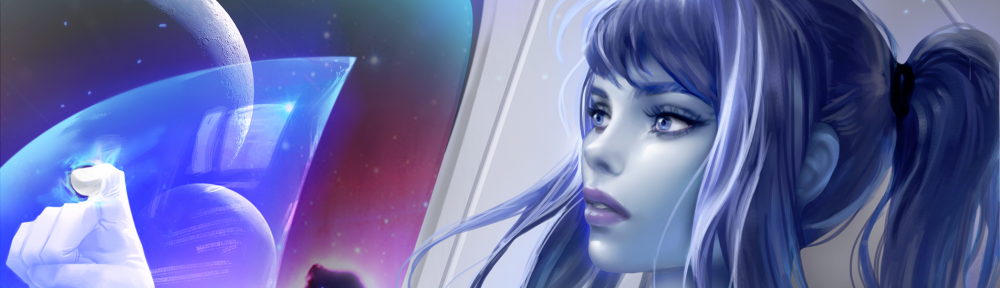
A gallery has been added to the site to showcase images relating to the universe of Orivar. Three works have been posted so far, so go check it out!
Atara’s eyes opened wide, forced out of her nocturnal delusions by an incessant pinging in her ears. Her first sight was of a lumigraph between her face and the room lit by the warm morning light, and it read, “Incoming transmission: Armada Admiral Harianan Aesho.” The captain left her comfortable position lying on her side beneath the blankets and rolled over, sitting up with the covers held over her body by her left arm. The lumigraph followed her as she moved, and Atara pressed a finger to it.
“Admiral?” Atara asked when the communication began. Her groggy speech betrayed her recent awakening.
“Good morning, captain,” Aesho said through the lumigraph in her usual shrewd tone. “Let’s skip the formalities. I need you to report to the nearest secure Q-comms facility immediately.”
“Xannissa and I are on vacation,” Atara told her. “Can this wait?”
“If this could wait, I wouldn’t be calling you first thing in the morning,” Aesho barked. “Your leave does not exempt you from the duties of your service. Now, I’m giving you the location of the nearest Q-comms center. Looks like it’s the FedSec headquarters about seven kilometers away. I expect a call within the hour. Aesho out.”
The video feed on the lumigraph disappeared. A few seconds later, she received a notification which, upon opening, gave the Q-comms address Atara was to contact.
Atara sighed. “Damn it!” she shouted as she hurled the covers away from her, revealing her naked body. Fuming, and as much as it would have calmed her down, she decided to avoid taking a shower for the sake of time. Instead, she stepped into the shield-scrubber and in less than a minute was pristine from scalp to sole. After cleaning her teeth and fixing her hair, Atara left the bathroom and returned to the bedroom, only to realize that Xannissa never came to bed. After putting on her boots and clothing herself in standard, she entered the living room and found Xannissa laid out upon the couch still in her bodysuit—the sunlight piercing the morning haze and shining on her white polyalloy.
“Xann,” Atara said, leaning over and rocking Xannissa’s hip. “Xann, wake up.” The Elestan’s eyes cracked open.
“What time is it?” Xannissa asked with a groggy voice. She put her hands on her face and stretched her back and arms.
“Seven after six,” Atara told her. Xannissa rose from the couch, yawning. “Aesho called me a few minutes ago. She wants us to contact her on Q-comms.”
“Is it important?” The Elestan was still coming to her senses.
“Apparently.”
“Damn. Let me clean up first.”
The exterior of the Federation Security Agency headquarters was a far cry from the posh crowd that lingered at the hotel. Federal police stood guard within and without, wearing dark, navy blue Accellus 3 marked with checker patterns. Their identities were masked by the black OPEL panels on their helmets. When Atara and Xannissa passed through FedSec’s entrance from the tower’s garage and transport hub, the guards stopped them at a security checkpoint. Despite their clear Military attire, the police granted them no exception. The two friends underwent a quick yet thorough scan before they were allowed to pass into the wide main corridor which featured a tall ceiling overlooked by offices with windows for walls. Professionally-dressed agents and officials who occupied offices within the government building hurried down the long stretch and the intersecting hallways. At the other end of the corridor sat a busy, curved reception desk with the meters-wide FedSec emblem behind.
“I don’t understand,” Xannissa thought to Atara as they approached the desk. “We’re walking weapons,” referring to the security check.
“I don’t think they understand either,” Atara told her.
Three others stood ahead of the two. When it became their turn for assistance, the receptionist took a call. Displeased, Atara leaned against the tall, dark stone table, supporting herself with her elbows and meshing her fingers together. Xannissa placed one hand on her hip and rested the other arm on the desk as her restless eyes darted from people, to lumionics, to a live news stream—one of four playing within the lobby encapsulating the reception area.
“We’re finally hearing about an attack that took place aboard a science station in neighboring Tribesson,” the anchorman reported, flanked by a picture subtitled with the story’s headline, “SCIENCE STATION RAID.” The anchorman was then replaced by a map of the Federation-Tribesson border.
“The raid occurred a week from yesterday in an unpopulated system about two-hundred lightyears fringeward of Federation Space. The small Akkain Technologies facility housed over five-hundred Federation citizens, mostly scientists, leading up to the assault by marauders whose identities are still unknown. Passing Navy vessels were quick to respond to the attack, instrumental in preventing further tragedy. The motivation behind the raid is not yet known.” The anchorman appeared again, and the headline next to him changed. “The meeting of the Transthalassic Accord between the Federation and Republic and their respective protectorates begins tomorrow, marking the bicentennial of the….”
“I apologize for the wait,” the female receptionist said. “How may I help you?” She looked at Atara with intent, and Xannissa’s gaze returned to the employee.
“Can you direct us to the Q-comms center?” Atara asked her.
“If you’ll just allow me to verify your ID,” she told them, engaging her workstation’s near-field EM-comms system to interact with their Accellus 4 suits, specifically their bracers which carried the transceivers. “Okay, Captain Atara Korrell and Commander Xannissa Cetalo?”
“Correct,” Atara said. She was still leaning on her elbows.
“I’ll give you the directions.” The receptionist generated a lumigraph and, holding it like a slip of paper, passed it and its contained information to Atara who copied the graphic in her hands and gave it to Xannissa. The two of them saved the information, and the lumigraphs vanished.
“Thank you very much,” Atara told the receptionist as she eased off of the table.
“No problem,” the receptionist said, and immediately gave her attention to the next person in line.
Lumigraphs projected upon their corneas acted as augmented reality displays. These lumionics, like most others, shined in one direction. Only the reflections of the lumionics were visible—subtle shimmers in the moisture of their eyes. They followed the guide to a set of lifts, down to a floor below the geological surface. There, they met more federal police who, after being supplied with the Q-comms address, escorted them to one of several doors. When it opened, Atara and Xannissa gazed upon the sunlit interior.
The pair stepped into a lavish office. The solid wood floor made little sound as they walked toward a white desk occupied by the armada admiral. Continuous OPEL panels exposed the room’s interior to an endless clear sky. Skylights flooded the center of the room with sunlight from the Akos star. Towering, snow-capped mountains climbed above the clouds. They were back on Lanan, but only in virtuality. Everything before them was a lumionic construct created from data transmitted through an instantaneous, two-way, quantum communications system that was impossible to intercept—technology identical to their neural interface link, albeit scaled up to handle more information. The technology is limited by connections. Links can only be formed in pairs, and arrays of Q-comms transmitters are required to communicate with multiple receivers.
“There you are,” Aesho’s image told them. The lumigraphic clock above and behind her signaled that it had been an hour exactly since the admiral called them. “This is urgent.” Aesho stood from her seat behind her desk and walked around it, seating herself against its front edge. She couldn’t be bothered to ask them about their vacation or apologize for impinging on their schedule. “Do you know of the Akkain station attack that happened in Tribesson?”
“No, I don’t,” Atara said flatly.
“I saw it on the news just minutes ago,” Xannissa told her.
“Of course,” the admiral said, “but it’s gone a full week unnoticed. All the Admiralty can hope is that it ends up under the rug.”
“Enlighten me,” Atara told her, folding her arms.
“Eight days ago, the same day as the start of our wargame, two black ships attacked a science station in orbit around a barren planet. These ships had been docked within hang—“
“What was the station researching?” Atara interrupted.
“Excuse me?”
“What were they researching?”
“Omnium.”
“Omnium?” Xannissa asked. “Why would an omnium lab be built in the middle of the boondocks?”
Aesho sighed and said, “See, the thing is, Akkain Tech is a company that is jointly funded by MARAD. As you know, corporations are stingy. Originally, the lab was built to study geology of all things. In order to rake in more money, they dropped the planet study and repurposed the station for omnium.”
“I see,” Xannissa nodded.
“If they were receiving MARAD money…,” Atara added.
“…they were working on something important,” Xannissa finished for her.
“Nothing gets past you two,” Aesho said. “You’ve seen too many things, as have I. Fiori.” Fiori’s orange figure appeared behind Atara and Xannissa, her hands on her lumionic hips. “I’d like you to be here while I explain this.” Aesho took a brief pause before continuing, collecting her thoughts. “The so-called marauders that attacked the station were soldiers on a carefully-planned mission. Not only did Akkain repurpose the lab, but they opened mining rights to the planet to rake in even more money. The attackers spent years building infrastructure right under their noses, and no one ever bothered to check.”
“Who are they?” Atara asked.
“The Elsheem State.”
“No way,” Xannissa exclaimed. “The only way they could have would’ve been….”
“That’s exactly right,” Aesho said. “Alliance backing.” Xannissa shook her head in disgust while Atara tilted one of her crossed arms to her face, placing her hand across her forehead such to conceal her eyes from Aesho.
“They’re looking to start a war,” Xannissa muttered.
“Not quite yet,” Aesho explained. “When they attacked, they made off with something of great value.”
“Oh yes, that important thing,” Atara said, sounding unamused.
“What is it?” Xannissa asked.
“The scientists are calling it ecksivar,” Aesho said, pronouncing the odd word ‘xvar,’ “but we’re calling it black omnium.”
“Never heard of it,” Xannissa remarked.
“Ecksivar,” Fiori cut in as she walked in front of them to stand next to Aesho, “is a novel variety of omnium with special attributes that cannot be disclosed at this time.”
“I see,” Xannissa nodded.
“How does this concern us?” Atara asked.
“You already know,” Aesho told the captain. “I’m giving you a ship.”
“I’m an instructor,” Atara explained.
“Not anymore.”
“I forfeited promotion.”
“Who cares?”
Atara dropped her arms to her sides. Deep down, she craved the feeling of calling a ship her own again. Xannissa knew this despite her never openly expressing it. The Terran captain was born for the stars. Just the possibility of being assigned a new command excited her, even being ignorant to the mission details.
“Before I accept,” Atara said softly, “I want a full rundown.”
“You say that like you have a choice,” Aesho laughed, moving away from her desk to stand near the room’s center. The windows and skylight darkened until they blocked out the sunlight, and the room fell dark without compensation from the lumionics. A string of tiny lumigraphs encircled Aesho’s front. She manipulated them with her fingers and flicked one toward the center of the room where it expanded to fill most of the space from ceiling to floor.
The three-dimensional representation that it became was a false-color graphic of subspace scanner data. It looked like a long, amorphous blob that could have possibly been in the shape of something manmade. “We registered this big bastard on subdar only a few hours after the attack from monitoring stations all the hell the way in Federation Space. That’s why the resolution is so poor. We have no idea how something so big slipped right into Tribesson. Honestly, that’s the least of my worries. I’m more concerned about the loot they made out with.” Aesho flicked another image in place of the first before continuing. “This shows the same craft several hours later. You’ll notice a change in aspect ratio. It’s a bit larger. And no, it’s not due to resolution. It’s in the same place as before. Those frigates that hit the station most likely attached to it, like a mothership. Whatever it is, Tribesson tracking stations are having a very hard time seeing it, but it hasn’t made it out of their territory yet. We have some ships following it, but I doubt they’ll ever catch up.”
“Then what hope do we have?” Atara asked her. “If I left from Lanan all the way on the other side of the Federation, I still wouldn’t catch them.”
“That’s where you’re wrong.” Aesho brought forth another image, this time a high resolution, true-color representation of a Federation starship. The ship’s curved exterior harbored anti-ship, dual cannon artillery, anti-strikecraft autocannon turrets, lines of hexagonal missile hatches, and circular doors for torpedo tubes. Two large bays, one on the port and the other on the starboard side opposite to each other, opened to the outside space. Between them was a hangar. The bridge was placed in the dorsal aft section of the ship as always, right before the seven fusion thrusters. The stern flared out some from the rest of the ship, forming shapes that looked like stubby wings. Altogether, the ship looked sleek and fearsome.
“This is the Kelsor-class,” Aesho explained. “It’s a battlecruiser designed for performing both fleet and solo ops; however, the latter is where it truly shines. Would you believe me if I told you they’ve finally cracked the synergistic drive?”
“So someone’s come up with a mediator able to regulate the drives?” Xannissa asked, not sounding terribly surprised.
“That’s right.”
“Able to make the ultra-precise adjustments to both so they don’t interfere?”
“Yes.”
“Then I believe you. It wasn’t impossible, just impractical.”
“GreDrive and Archetype made it practical,” Aesho continued. “The energy and space savings are a designer’s dream. They’ve had the room to pack a battleship’s payload into the smaller form of a battlecruiser, give it a spacious hangar, several large cargo bays, and they were also able to cram in a small omnium refinery. Whatever space they had left went into four simulators and general comfort. This ship was built for long solo missions. It puts the cruiser back into battlecruiser.”
“I get it,” Atara stopped her. “There’s only one thing I’m interested in: is it fast enough?”
“Is eighty-four-hundred c fast enough for you?”
“Eighty-four-hundred?!” Xannissa exclaimed.
“Is that good or bad, Xann?” Atara asked.
“The current standard is about seventy-three-hundred. They’ve broken eight-thousand!”
“Our elsheem friends are going a little above that at seventy-six,” Aesho told them. “That’s why we can’t catch them.”
“That ship they have is probably a flying hyperwarp core at that point,” Xannissa noted.
“You’ll have the privilege of commanding the first of its kind,” Aesho told Atara. “As such, yours will be named the Kelsor. The Navy plans to have five-hundred of these commissioned before the end of the year, and another two-thousand the next.”
“When do we leave?” Atara asked. She felt anxious now, realizing this was her reality.
“The first ship is being built as we speak. They started about five days ago, so if there are no problems, it should be finished three days from now. Of course, it’ll have to be looked over, taking a few more days before it’s mission-ready. How much longer is your vacation?”
“Until next week. Six more days.”
“If you’re content with jumping on a starship the moment you return to Lanan, then stay on Earth until your leave is over. I’m giving you the ship’s specifications, crew roster, and mission details. Of course, this is all classified.” Like the receptionist, Aesho generated a pair of lumigraphs and handed them to Atara and Xannissa. “The mission is simple: stop the enemy ship from reaching the Elsheem State and retrieve the black omnium. Fiori will fill you in on the details of said ship as we gather more intelligence.”
“Is that all?” Atara asked.
“There is one more thing,” Fiori said. “The marauder’s path is currently projecting toward the Saraian Range.”
“Oh dear,” Xannissa said.
“I expect they will traverse around the upspin edge of the Range,” Fiori continued. “The Kelsor has a greater chance of success if it skims the downspin side.”
“Ideally, we’d try to trap them in there,” Aesho said, “but as we can’t catch them, it’s really no use. We’ve already begun coordinating with the Republic and they are willing to help as much as they can, but this is a Federation matter. Do not forget that. That is all, ladies,” Aesho nodded to them. Fiori waved goodbye as the entire lumionic construction within which they were immersed vanished, leaving them inside a small, featureless room.
“Well,” Atara said, still holding the lumigraph the admiral gave them, “what do you think?”
“You know me,” Xannissa told her friend. “I’ll follow you to the edge of the galaxy.”
“What about Aedan?” At this, Xannissa’s heart sank. After thirteen years of living on base, no more missions, she was finally ready to settle down. Her engagement to Aedan just the night before complicated matters.
“Well,” Xannissa said, pondering her situation. She brought her fist under her nose supported by her other arm, thought for a moment, and then dropped it back to her side. “Aedan’s waited this long. He’ll just have to wait a little longer.”
“Will he understand?”
“He’s always been understanding. I just really hate to put him through this. But I’ll make sure this is my last mission. A few months in deep space with a synerdrive that actually works, and I think I’ll have had my fill.”
“Okay,” Atara said. “I think it’ll all work out for you.” Atara didn’t like to be reminded that Xannissa didn’t share her passion for deep space, or that this very well could be the last mission that they ever shared.
The pair’s brief exchange after the end of the transmission prompted one of the guards to check on them, and they were kindly escorted to the lifts. Once back at the surface, they noticed the overcast begin to roll in, and it rained that entire afternoon. Blue Road, situated above the stratus layer, was packed with visitors, but the two returned to see and do things they hadn’t gotten the chance to do because of Metro Aero. This is where they discovered that Cylenna had won the championship. She took pictures and signed autographs for the crowd. Xannissa attempted to avoid her, slipping through the sea of bodies, but Cylenna called out to her across the vast atrium, freezing her in her tracks.
“Wow! You’re Spectre’s sister?” shouted an enthusiast.
“Is that what they’re calling you now?” Xannissa asked. Cylenna’s arm was around her neck as they posed for pictures.
“That’s what they’ve always called me, remember?”
Xannissa decided it was best to withhold anything about her engagement. The two stayed at Blue Road until after dusk. Once finally back at the hotel, they stayed up a little longer only to stare at the mesmerizing cityscape before they crawled into the same bed, as service partners typically did. Xannissa was out like a light. Atara’s eyes stared at the blank ceiling for hours until, finally, her thoughts carried her away into that whirlwind of nocturnal delusion.
The Soran spaceliner shut down its fusion engines, choking the white fire from its thrusters as it drifted into an open bay in the spaceport. Propelled by its gravitics, the hulking, yellow civilian vessel guided itself into perfect position. Station-side gravitics and lumionics held the ship stationary, and mechanical gates at the sides of the dock rotated to face the craft, telescoping into place along eight points across the ship’s port and starboard sides.
After a half hour of unloading passengers, Atara and Xannissa passed a lumionic sign warning of possible variable gravity as they crossed one of the dock’s boarding platforms. Wearing their usual Navy standard uniforms, they moved with the crowd as it flowed toward the heart of the Kardann International Spaceport in orbit above Earth. Behind them and visible through the OPEL windows, the spaceliner’s clean hull shined in Sol’s white light. The pair carried nothing with them except their Accellus 4.
The crowd was a homogenous mixture of all six human races. Peach and brown-skinned Terrans walked beside gray-skinned Elestans, blue Zelnarans, lavender Larissians, blood red Yerans, and green Exans. The six races of the Sister Worlds had coexisted peacefully long before the rise of Mirida, and nothing could ever change that now or in the future.
The two left the gate and emerged in the terminal, meeting a mighty river of bodies flowing perpendicularly to them in both directions. Atara took the lead and held Xannissa’s hand, trying to stay together despite the surge of pedestrians. The noise of scuffling and clacking feet and loud voices were drowned out only by the terminal’s public-address system that announced imminent arrivals and departures.
It was almost a complete certainty that everyone in the terminal and station was wearing some form of REMASS clothing. Many clothed themselves loosely—some heavily and some thinly. There were civilians, both male and female, that wore bodysuits as well with some more or less form-fitting than others, a few even defeating modesty. And then there were those who took advantage of public decency laws which allowed males to expose everything above the waist and females everything below.
“Was it this crowded the last time we came through here?” Xannissa asked through her neural interface.
“I don’t believe,” Atara thought, clutching Xannissa’s hand. “Then again, it’s a planet of a hundred billion.”
“And a system of five-fold more.”
Beyond the terminal, they waded toward a balcony like it was the shore, and it overlooked a shopping area that stretched out beneath them. Xannissa anchored her forearms to the railing and leaned against it, watching the people meander in and out of stores and restaurants.
“We can wait here for a bit and see if the crowd thins out,” Xannissa said after facing Atara, despite not needing to move her lips.
“Let’s see,” Atara told her, still unwilling to talk above the noise.
“I know I keep saying this,” Xannissa thought, watching a small child bouncing before his parents, “but I wish Aesho would retire.”
“She’s been the armada admiral at least as far back as Semarah,” Atara said, propping her buttocks against the railing, crossing her arms, and staring into the incessant influx.
“She was one when your mother was alive!” Xannissa added, her transmitted voice filled with vexation. “And they made you quit commanding starships. Talk about double standards.”
Atara sighed and said, “That’s just the way things are.”
“Man.” Xannissa shut her eyes and shook her head. The Elestan thought for a moment, watching the little boy trip and fall, only to stand back up on his feet and keep frolicking like nothing had happened. She turned to Atara and thought, “You’ve done a lot of good as an instructor, maybe even more than captain.”
“You really think so?” Atara asked, turning to her friend. The crowd had dried up some.
“I do,” Xannissa vocalized. “And Naret is proof of that.”
“She still has a lot to learn.”
“Don’t we all? I mean, if you’re not learning…”
“…You’re dead.”
Xannissa smiled. She left the railing and straightened her body. “She’ll have the opportunity to build more experience.” She brought her right wrist up and adjusted the end of her sleeve with her left hand before saying, “Shall we go?”
It was Xannissa who seemed to be taking the lead as the pair descended toward the shopping area. Scents of hot brunch wafted from a café as they passed, beckoning Xannissa who had yet to eat breakfast toward the establishment. Atara stopped her halfway through the door saying, “We’re eating lunch soon, right?” Xannissa faced her, sighed, and rubbed her flat abdomen as it ached.
“Fine,” Xannissa huffed. They walked away from the café and continued on toward the station’s core.
They caught a tram to the surface departures area of the station. Shuttles passed through large airscreens and parked next to loading zones. Each zone corresponded to one surface station located on a different continent. The two avoided these, heading instead to the more expensive and direct private cabs. A bright red sports model flashed a lumigraph with “CETALO” written in bold text. They approached the craft, and its top and sides were recalled via a rapid recovery system not unlike that in Accellus 4, revealing the gravidyne’s dark, luxury interior. Atara sat down on the leather front left seat and Xannissa on the right. Once they were inside, the top and sides were rebuilt by REMASS, and OPEL panels surrounded them.
“Greetings, ladies,” the car’s registered Subnet personality told them in a smooth male voice as the gravidyne rose from its parking spot. “Xannissa, I notice you have a reservation at the Sasrin Resort near the Capitol Complex. May I take you there?”
“That’s it,” Xannissa told the integrated assistant. The vehicle crawled through the station’s interior air, passed through an airscreen, and then directed itself toward the planet and accelerated.
“Would you care for some music?” the IA asked. Xannissa looked at Atara, waiting for an answer.
“Why not?” Atara asked. As the smooth music played, Atara turned to Xannissa who was still looking her way and asked, “How is Lieren doing?”
“You mean about the Akkain station? She still hasn’t been able to talk to her father.”
“At least we know he’s all right.”
“The poor girl lost her mother some years back,” Xannissa told her. “I don’t know the whole story, but she was in the Defense Force.”
“I hope she can reunite with him,” Atara said. She rested her left hand on her face. “They seem like they only have each other.”
The sports gravidyne streaked through the upper atmosphere and joined the skylane traffic flow. It was about mid-morning in the western hemisphere. The IA piloted the car to the hotel’s busy main entrance. Fashionable guests walked in and out of the automatic doors, to and from expensive aerospace gravidynes that they either owned or, like Atara and Xannissa, had rented. Once their gravidyne stopped, the top of the vehicle retreated, and the pair stood from the craft. Xannissa’s fare was paid electronically as soon as the cab reached the destination, and the gravidyne departed as soon as the two walked away.
The pair strode through the automatic doors and across the wooden floor of the ornate lobby decorated with metallic statues of dignitaries and at least one instance of stasis art. Four naked performers—two male and two female and very attractive—stood together on a pedestal, frozen in lumionic stasis. It was understood that stasis artists earned a sizable salary, but at the cost of being absent from reality for hours, days, even weeks. Shallow pools separated parts of the lobby; their undisturbed surfaces like solid glass. Leafy trees with sprawling branches shaded open pavilions built atop the water from the sunlight streaming down from the skylight hundreds of meters up. Exposed corridors flanked by rooms upon rooms formed the walls of this great atrium.
An Elestan woman with her black hair in a bun behind her head leaned on the reception desk. She wore the Navy’s enlisted formal uniform consisting of a white shawl draped over her shoulders and concealing a vest underneath. Her bare, neutral gray buttocks and genitals were clearly visible as she wore no bodysuit. When she departed the desk, her black tie hung down her front with its inverted tip swaying above her navel which sparkled from the small, clear gemstone within. Giant hooped earrings hung from each of her earlobes, and hair fell to either side of her face like Xannissa’s.
“No way,” Xannissa mumbled to herself. “Cylenna?” The woman’s eyes had jumped from place to place, then landed squarely on Xannissa. The beaming woman shouted to them as they approached.
“Xanni!” Before Xannissa could properly greet her, Cylenna smooshed their clothed bosoms together, wrapping her arms around Xannissa’s back.
“It’s been far too long,” Cylenna said after releasing Xannissa from her grip. She then followed up with a smooch on Xannissa’s right cheek.
“I’m shocked you haven’t gotten yourself killed yet,” Xannissa told her, rubbing her hand on her face and showing a wry smile. “Anyway, what are you all dressed up for?” she asked despite Cylenna’s relative nakedness.
“Metro Aero,” Cylenna told them. She looked to Atara and said, “How’s the captain doing?”
“Just surprised to find you here,” Atara said. “Other than that, I’m glad to be away from Lanan.” She paused before stating, “I don’t think I’ve ever seen you wear the uniform.” Her rank insignia denoted a master chief petty officer and strike pilot.
“Right?” Xannissa laughed. “It’s like she’s just as proud of that as she is of her own body.”
“Oh? If that’s what you think,” she retorted, knocking away the tie and positioning her hands to unfasten her vest.
“No, no, keep your shirt on,” Xannissa told her older sister, looking over her shoulder to see if anyone was staring at them, but everyone across the lobby appeared to be absorbed in their own worlds. Cylenna grinned and brought her arms down. “So,” Xannissa continued, “Metropolitan Aerospace?”
“Yeah. You’re not here for that?”
“I haven’t kept up with racing in so long,” Xannissa told her. “But it gives us another thing to do.”
“Oh, okay,” Cylenna said, masking her disappointment. “You two just here on vacation?” As she spoke, Cylenna spotted a familiar Terran male walk through the autodoors. Lumionic sunshields hovered before his eyes.
“Something like that,” Xannissa told her, reluctant to mention Aedan.
“Well, it looks like your company is here, so I should be leaving,” Cylenna told them. She squeezed between the two friends and slapped her younger sister’s hyperdermal laminated buttock as she passed.
“Leaving already?” the Terran shouted to her. “I just got here!”
“You can’t keep up with me,” she told him, guffawing as she pranced through the autodoors.
“Older sisters,” said the man walking up to them while shaking his head. His short hair was brown and his skin a shade darker than Atara’s. His casual dress belied the true nature of his life as a serious business executive.
“Kyle!” Atara said, hugging her younger brother as his sunshields disappeared.
“Great to see you, Atara!” he told her with his arms around her. After they released each other, he asked them in his masculine voice, “Have you two checked in?”
“We were about to before we were stopped by Petty Officer Deathwish,” Xannissa said.
“I see,” Kyle told them. He followed the pair to the reception desk, and to the two women’s astonishment, paid for their week-long stay in advance plus extra. He then followed the pair up to their room high above the lobby.
Xannissa sat across from Atara and Kyle in a booth around an oval table. On one side was an OPEL panel with an uninterrupted view of the outside, revealing a lustrous skyline. Distant duralithic monoliths towered above the city, brushing against the rolling cumulus clouds and reflecting the sun’s blinding light. Their hotel, faded by the atmosphere between them, was among the buildings shooting up from the ground. Currents of gravidynes confined to skylanes crisscrossed the air. Below them was a sprawling urban landscape with many of the roofs topped with gardens, greenery, or windows. The capitol district was the most pristine urban area on the planet. If not for the telltale signs of an abundant population, it would have appeared like no one had ever lived here.
On the other side was the dark restaurant. The majority of the light was from the ribbon of OPEL windows wrapping around the outer walls. The restaurant spanned multiple levels, and the interior dipped down into a secluded depression where a party could slip away and enjoy a private meal and drinks. The atmosphere from the waiters and the music to the walls, ceilings, floors, and greenery boasted high class. Other than the music, the air was filled with the clanking of glass and plates, the clinging of silverware, and the mumbling of low voices.
Atara and Xannissa wore their formal uniforms. They sat with their exposed legs crossed and their hands in their laps. Kyle swapped his casual clothing for a suit more appropriate for the venue using his civilian REMASS.
“When is Aedan coming?” Kyle asked, holding his steaming cup of fragrant coffee and looking toward the restaurant’s interior.
“He’s nearing the deadline on a project,” Xannissa told him, “so he can’t leave until this afternoon.
“I see,” he said. He took a sip from his cup. “If we had him, and if I could have grabbed Cylenna, it’d be like our good ol’ high school days.”
“How would Talme feel about you wanting to grab my sister?” Xannissa asked in jest. Kyle set his drink down, bursting into laughter with Xannissa.
“She knows I like Elestan women!” he shouted. “That’s why I married her.”
“Keep your voice down,” Atara told her brother, patting him on the shoulder.
“So, yeah. Speaking of, I probably should return to my wife after this.”
“How are the children?” Atara asked him.
“Sara just turned nineteen,” Kyle said. “Jess and Rin are in high school now.”
“Are they all you have?” Xannissa asked.
“So far,” Kyle said, lifting his cup and taking another sip. “When they clear the nest, we’ll think about raising another upbringing. This time Talme wants Terrans, and at least one son.”
“That’s sweet!” Xannissa said. “We’ll have a little Kyle Junior!”
“Don’t start!” Kyle laughed again. He cut his laughter short as the waitress returned with their food. She left them with three steaming plates and a couple of cold saucers with condiments. The three lifted their utensils and dined upon their lunch.
“Sara wants to join the Military,” Kyle said before taking his first bite. He chewed, swallowed, and then continued, “She reminds me of mom.”
“What’s today?” Atara asked, halting her hands. She looked at her brother with concern.
“Oh-five-two-one,” he told her. “The anniversary. I thought about it at the office this morning before coming here.”
“This year is the first time I haven’t thought about it,” she told them, slowly slicing her food. “I don’t know how I should feel about that.”
“It’s probably a good thing,” Xannissa told her. “It’s been, what? Seventy-seven years?”
“Yeah,” Atara said softly. “You’re probably right.”
Kyle’s boundless generosity, other than making him a subpar businessman in the eyes of his peers, compelled him to pay for the meal and for Atara and Xannissa’s fare for the trip back to the hotel. It wasn’t long after that Xannissa received a call from Aedan saying that he was free for the day and that he would bring a gravidyne to pick them up. From there, the new trio traveled to Blue Road, a shopping and entertainment district spanning the tops of seven close towers.
When the gravidyne landed in the bay, Aedan dashed out and helped Xannissa—in standard again—out of the front seat. She gave him a brief look of subtle annoyance, implying that she was perfectly capable on her own, but she kindly took his hand and rose from the car, smiling at him. Aedan was also a Terran. His jet black hair, parted on the side, glistened in the lights of the lumionics and OPEL panels, and his facial hair was well-kept. He wore a dark gray business suit without the jacket. The thought of leaving the two of them alone crossed Atara’s mind, and that thought must have transmitted to Xannissa because she responded with her NI.
“You coming?” It was then that Atara—also back in standard—realized she was still inside the vehicle. She stood up from the gravidyne and joined them.
OPEL windows were placed throughout the conjoined structures, giving guests the feeling of walking among the clouds. Being at the current cloud level, the only thing above was a deep blue sky. Escalators moved over giant OPEL panels embedded in the floor. The images they projected were so clear that they could have been mistaken for openings with drops of at least a couple thousand meters. Plants and shrubs lined the immaculate white walkways and storefronts, and lumionic lighting streamed down from the OPEL ceiling. The interior design was reminiscent of that at the Lanan Sector Academy, albeit more open and brighter due mainly to the widespread use of continuous OPEL panels. Lumigraphic banners advertised the Metropolitan Aerospace Grand Prix, and Blue Road, being one of the best places to view the event, was already packed with enthusiasts who would stay out until morning.
“Looks like Metro Aero is getting all the attention today,” Aedan pointed out. He walked with Xannissa hand-in-hand. Atara strode by her friend’s other side.
“Cylenna’s competing,” Xannissa told him.
“Really now?”
Xannissa nodded, then sighed. “I can’t believe some of the things she does.”
“It may be reckless sport,” Aedan said, “but she’s following her passion.”
“I know. I just don’t want to lose her.”
“I know how you feel, Xann,” Atara told her, “but Aedan has a point. Better to lose her doing what she loves than to keep her doing what she hates.”
The trio moved toward a booth operated by the Federation Navy situated in one of the great atriums. Xannissa was unsure how to feel about the five-meter-tall, flat lumigraph of her sister in standard uniform, and Atara tapped her on the shoulder to look at it as a sort of tease. The petty officers running the booth noticed the rank insignias on Atara and Xannissa’s uniforms, and they jumped up from the young and curious civilians they attended to to give a hearty salute.
“At ease, ladies,” Atara told them as the trio passed by. The group continued to walk toward a more secluded area, but finding one was proving difficult.
“So, Aedan, I thought you were going to be busy,” Xannissa told him. Atara caught her smile.
“Well, deal is,” Aedan said softly, “I practically begged my boss to let me go. I told her my favorite person was in town and I had to leave as soon as possible.”
“Is that true?” Xannissa gave him a playful, inquisitive glare.
“Would you still believe me if it was?” Aedan gave her a smile while gripping her laminated hand tighter. “I mean, you are my favorite person.”
“You’re too sweet. You know that?” Aedan chuckled a little when she said this.
“Give me a break,” he said. “I haven’t seen you in months.”
“Speaking of, how’s that project coming?”
“Really smoothly,” he said. “A lot more smoothly than I ever imagined. The Jackknife will be ready for licensing within the year. I kinda wanted to surprise you with this, but I can’t contain myself. After the Jackknife is done, Klade is moving me to Lanan.”
“Really? That’s fantastic!” she told him before joyfully giggling. The two of them moved closer together, hugging each other from the side.
Atara couldn’t help but smile as she watched them. Aedan was a good man, and she could see few others with her best friend. The only thing she questioned, and she discussed this with Xannissa on rare occasion, was Aedan’s seeming reluctance with regard to marital commitment. Of course, neither she nor Xannissa were yet married, but their former lives abroad obstructed that to a high degree. Aedan had only one good excuse, and that being he was waiting for the one.
As the sun was setting over the city, the three made one more leisurely lap around the indoor gardens before heading back to the bay and grabbing a cab. They had eaten a pleasant dinner at a restaurant next to an artificial pond shaded by a sprawling oak. Children ran through the grass while their parents and families sat and stood, watching the Blue Road reach critical mass leading to the grand prix.
Atara entered the hotel suite first, followed by Xannissa and Aedan. The lights were low, and the distant skyline seen through the living room OPEL glittered like platinum. With their standards still on, the two officers removed their boots in their bedroom. Like their hands, their toes were laminated separately, allowing them to wiggle and move independently from each other. A wide couch sat in the dim room in front of the window through which the sum of the city’s urban light streamed in from. After sitting down upon the cool upholstery, Xannissa darkened the low lights, leaving the kilometers of outstretched capitol, the glowing from the open bedroom door, and the subtle luminescence from parts of their Accellus 4 as their only sources of light in the night. Atara sat cross-legged with her legs on the seat. Xannissa brought her legs up to her body such that her thighs touched her breasts. She wrapped her arms around her legs and pressed her face against her knees, looking over them out at the dense sprawl. Aedan crossed his legs at the ankles, slouched down into the couch, and meshed his fingers together over his abdomen.
The majority of the skylane traffic that should have filled the sky was gone, redirected to lower altitudes. A new surge of gravidynes appeared far off. Three-hundred racers, all on aerobikes, charged through the air on a virtual course that took them around buildings, through open air, and inside transit hubs. The course was in a constant state of change with the layout of the invisible track changing from one lap to the next. Pilots were encouraged to stay within the bounds of the course with the promise of penalties when it came time to calculate final scores.
“This is one of those moments,” Xannissa whispered to them, “that you just want to pause and experience forever.” The flock of gravidynes arced across their view. Cylenna was somewhere among them having the time of her life.
“I agree,” Aedan said. Suddenly, nervousness and apprehension filled his body. This was supposed to be a moment to enjoy with his longtime friends, yet his true goal screamed in his mind. In order to fulfill that objective, destroying this ideal moment was an inevitability.
This is it, he told himself. I can’t let a passing comfort interfere with this opportunity.
“Xannissa?”
“Aedan?” Aedan stood up from the couch.
“I have something I want to ask you.” He kneeled right in front of where she sat, looked her straight in her blue, glistening eyes, and said, “Will you marry me?” His hand reached into his pocket, and from it he withdrew a ring of shining platinum banded with orivar.
Atara and Xannissa both gasped, processing his most serious question. In an instant, and seemingly on a whim, their peaceful moment turned into an important life decision. Aedan, a man who had not, to Xannissa’s knowledge, romanced another soul in his one-hundred-fifteen-year life, prostrated himself before her. She knew everything about him and loved him for who he was and had always been, and he the same for her. She dropped her legs to the floor, passing them to either side of him. Bringing her whole torso to the edge of the couch, she leaned forward.
“I will,” she whispered before kissing him on the lips. Atara sat with her hands clasped in front of her face. After their brief exchange, Xannissa asked through a grin, “What took you so long?”
“When you went away to the Academy all those years ago,” Aedan said, returning to his seat, “I thought I would stop loving you. I never did. Ever. Plus, now that you’re an instructor, what better time to settle down and start a family?”
“Hold on,” she said. “We’re not married yet. First things first. I know you’re excited, and so am I, but you can have me after the wedding.”
“I wouldn’t have it any other way,” he told her.
The three of them spent the rest of the night alone in their suite high above the urban landscape, watching distant racers compete for glory in a dangerous sport upon open gravidynes. They reminisced about their lives, both the interesting highs and fascinating lows. They even discussed the nature of life itself. As the hours dragged on, Xannissa rummaged through the foodfab’s programs for a snack, and Aedan admitted he had work in the morning. Three became two, and then two became one as Xannissa, still high on emotions, sat awake and alone in the living room until the eastern sky broadcasted the earliest sign of the beginning of a new dawn.
“We recovered the pods from the planet’s surface,” Sesh reported. Her right arm lied straight across the table as she tapped her fingers inaudibly on the surface. “Inside one of them was the omnium scientist, Doctor Quen Souq, accompanied by the security officer, Krystal Zara.”
“That’s good news at least,” said the captain. Sesh, Kyora, Virn, and the captain were gathered within the Vonn’s briefing room located just aft of the bridge. They were all in standard uniform now with Kyora’s and Virn’s being orange with white stripes. “Akkain was worried about him.”
“So, what we know now is that the attackers wore unmarked black armor and arrived in unmarked black ships. The only thing we have to go on is that they appeared to be of Alliance design. No one has claimed responsibility yet, unfortunately.” The captain paused for a second before saying, “I do need to tell you something. This station was originally constructed to study the planet’s geology. Hadrast Four is exceptionally mineral-rich. Somewhere along the way, Akkain lost interest, repurposed this station to study omnium, and began leasing mining rights to the planet.”
“It’s interesting that people still choose to mine in this age,” Virn said.
“Bulk minerals,” said Sesh, “if you can find them dense enough, could be acquired at less expense and with less regulations than using omnium. They basically let anyone and everyone start digging in their backyard in order to turn a profit and put the lives of these scientists in danger.”
“While our surface probe was locating the pods, it came across the entrance to one of the mines,” said the captain. “We sent the probe in, but the density of the planet’s crust prevents em-comms signals from penetrating the surface, and we can’t get a sub-comms signal through.”
“It could be subspace jamming,” Kyora said.
“That is a possibility,” said the captain, “but the probe would have returned to the surface and told us if it had encountered any—that’s assuming the probe was still functional. Either way, we need a recovery team down there, as if things weren’t crazy enough.”
“According to the station’s logs, the frigates originated from the surface,” Sesh said. “There’s no telling what we’ll find down there, but I’ll leave immediately, taking a small team and a shuttle.” The captain nodded at her.
“We have the landing ship,” Kyora said. “I can order it to touch down.”
“That may come in handy,” said Sesh looking at Kyora from across the table. “Actually, if you and Lorralis wouldn’t mind accompanying me.”
“Certainly,” Kyora said as Virn nodded.
Sesh once again called on her best Auroras as she left with Kyora and Virn aboard the shuttle. The craft dove through the atmosphere dominated by colossal cumulonimbus that created large, dark shadows in the orange evening sky. Flashes of lightning, diffused by the thick clouds, climbed the dark sides of the towering storms.
“Giants danced to thunder’s sound,” Virn whispered, “growing louder as they bound toward the heavens, they rise through evening golden skies.”
“So, colonel,” Sesh spoke, disrupting the relative quiet. She looked across at Kyora. “Where are you from?
“Me?” Kyora looked surprised by the question. The Elestan looked down, then back up and said “Mirida.”
“Oh, Mirida,” Sesh said happily while nodding. “What is it like there?”
“I haven’t lived there in decades,” said Kyora, attempting to dismiss the question. Getting the hint, Sesh turned her attention to Virn.
“How about you?”
“I’m from Kol,” Virn said with her hands folded in her lap. She seemed far more receptive.
“Ah, a Sister World,” Sesh noted. “That must have been nice.”
“It’s a beautiful place. I grew up in the far north, so a lot of tundra grasslands and a few forests with some hills here and there. There was a stream that ran just down the road from our house. We left every winter and lived in the tropics for five months, but we always considered the far north our home.”
“That sounds really nice,” Sesh repeated.
“How about yourself?” Virn asked.
“I grew up on the very edge of the Frontier.”
“So you were really close to the Federation?”
“The other edge,” Sesh stressed. “The very far edge.” She attempted to illustrate by moving her hands far apart. “I think I still remember the planet’s official designation: U-P-C, two-eight-five-nine, three-five-four-oh, two-three-four-G.”
“That sounds a lot like a colony,” Kyora stated.
“It was,” Sesh explained. “Actually, the colony was only twenty years old when I was born there. We called it Regen-Kelas Four. I, too, grew up in the grasslands, but it was a temperate region that our family farmed. There wasn’t enough omnium around to use it for food. Actually, the first time I ever saw a food-fab was when I first came to the Federation when I was twenty-seven. It took three years just to make that trip.”
“Do you ever see yourself going back there?” Virn asked.
“I enjoy the fast life of Civilized Space,” Sesh told them, “but I dream sometimes about going back there. Talk about having free reign over your surroundings. One of my favorite things to do as a child was explore with my brothers. I was the youngest of the five children in my parent’s first upbringing; and the only female at that. Despite being the youngest and ‘cutest’ as my brothers would say, I followed them over hills, across valleys, into empty forests. We even made it to the mountains once, on foot, in winter, and it took us about a week to get there and back.”
“It sounds like you really miss it,” Virn said.
“Why did you leave, then?” Kyora asked.
“I used to know,” said Sesh. “It was just the adventuring spirit, I guess. There was also this one time when I was really young that we had a raider scare, and I remember being very frightened.” Sesh turned to look outside at the evening sky as they continued their descent. “Maybe that’s why I chose to join the Navy.”
“I’ll never go back to Mirida,” said Kyora.
“Why is that?” Sesh asked as she turned back to the two of them. Kyora ignored the question.
“I don’t see myself going back to Kol,” said Virn. “My family was very deep in ancient Exan religion. My father was always away performing sacred rites while I was educated by my mother who herself was a poet. After her instruction, I tended the local shrine and had to wear large, bulky ceremonial garb and have my hair done a certain way. It was both my parents’ intention for me to go out into the wider world when I turned twenty, but what I didn’t tell them is that I wanted to join the Navy. When they found out I was in the Academy, they showed up there and tried to drag me back.” Virn almost laughed. “The first time I tried on REMASS clothing, I was in heaven. It was so comfortable. My parents now have a son, and he seems to be following in father’s footsteps.”
“That’s very interesting,” said Sesh. “Colonel, are you sure you don’t want in on our conversation?”
“Very sure.”
The shuttle touched down on the windswept rocky plain in front of the mine entrance. Everyone aboard had sheathed themselves in armor and helmets, but did not tote weapons. They could fabricate their weapons on demand if they became necessary. The Auroras and two Assault Force officers stepped off of the shuttle and gathered around before heading into the large, sloped, rectangular tunnel with walls one-hundred meters apart and a ceiling thirty meters up.
“Be advised,” the captain told the away team after Sesh announced their arrival, “a wave of storms will reach your location within three hours. Also, remember to be on the lookout for subspace jamming.”
“Understood, captain,” Sesh responded in her helmet.
“If you aren’t back by then,” said the captain, “you’ll need to seek refuge in the caves until the storm blows over.”
The team of twenty-seven set off into the dark tunnel. The ground was quite smooth compared to the outside which was littered with loose rocks and pebbles. They kept their suits’ lights off and relied on optical sensors, primarily taking the form of advanced lidar. A light wind blew toward them from deeper within.
“There is some kind of ventilation system five-hundred meters ahead,” said Sesh. “That’s the only thing we got before the probe disappeared.” Sesh turned to one of the two discthrowers and said “Can you give me eyes ahead?”
“Affirmative,” said the discthrower. She was lightly armored, and she removed what looked like a flattened torus from her back. The disc was actually a drone containing a separate omnium supply that was under her conscious control, placing her in the situation of being simultaneously in charge of both her own body and every action of the drone.
The discthrower held the disc—about thirty centimeters across—to her opposite shoulder and flung it into the darkness. The disc took off under its own gravitics and raced down the tunnel, seeing everything despite the dark. At the end of the tunnel was the ventilation system. It formed a wall with three large circular openings. Each opening contained a rotor with three connecting blades. The rotors remained motionless, so the discthrower guided her disc between the gaps in the blades and further into the tunnel. After reporting no resistance for two kilometers, Sesh ordered her Auroras to lift off—that is, to use their gravitics to fly down the tunnel. They slowed down as they carefully guided themselves through the rotor blades.
“If the vent is off,” asked one of the Auroras as she fit her body through, “where is the breeze coming from?”
“Perhaps it’s the storms,” Virn stated, “the low pressure they generate.”
The Auroras continued to fly until they reached a sharp drop. Setting their feet down on the smooth stone, they peered over the edge of a giant, vertical, cylindrical shaft. The other discthrower unleashed her disc into the blackness helping to map out the tunnels.
The vertical shaft’s stone ceiling was directly above them, and the shaft’s floor was three kilometers down. More tunnels of similar dimensions to the one that the Auroras stood within jutted off from this main shaft. Automated gravidynes crawled through the tunnels, just barely managing to slide between the covalent nanocrystal and duralithic supports preventing tunnel collapse. The discs continued to explore unimpeded despite the dense metallic rock surrounding them because of their sub-comms links with their users. That was until one of the discs suddenly lost communication.
“Commander,” one of the discthrowers said with concern. “I just lost my disc.”
“We may have found something, then,” said Sesh. “Would you be able to guide us to the location you lost it?”
“Affirmative.”
The team used their gravitics to descend through the shaft and perch at the entrance to the tunnel in which the disc was lost—standing or kneeling on the wall of the shaft as if it were the ground. One of the lightly-armored scouts attempted to use her mass scanner to detect movement, but could see none down the tunnel. Optics were also clear, so Sesh gave the order to proceed.
Once within the disc’s line of sight, the discthrower was able to guide it back to herself using EM-comms. She caught it and clutched it to her chest as if she had just recovered her lost pet. One-hundred meters down the tunnel, the group lost their sub-comms connections to the ship and to each other. Each of their Accellus 4 confirmed it as jamming.
“That’s it,” said Sesh. “Definitely proceed with caution.”
“Subspace jammers interfere with mass scanners,” said Virn, “so be on your guard.”
Sesh stepped outside of the jammer’s area of effect long enough to contact the Vonn, and then the group walked slowly down the tunnel.
“I see something far ahead,” said one of the point-men. “It may be the probe.” The group approached the object on foot and activated their lights to look it over. The probe’s SIRAC shined in the light they emitted despite how heavily it had been damaged. Suddenly, Kyora felt a familiar feeling—the same kind that had kept her alive all these years. It was always just a feeling, but she knew without a doubt that danger surrounded them. She activated her shrouding, concealing her from all sensor types including the human eye. Virn noticed this immediately.
“Something’s wrong,” Virn said, worried. As she finished her sentence, four hidden gun turrets emerged from hidden doors in the smooth rock: two on the walls, one on the ceiling, and one on the floor.
“Take them down!” Sesh shouted. Before the one on the floor could start firing, Kyora had blasted it to a molten husk with her dual heavy pistols. The other three began firing at the Auroras, echoing the popping of chemical propellants through the tunnels, but their Accellus 4’s lumionic barriers absorbed the kinetic energy of the turrets’ solid rounds. The discthrower who had just recovered her disc sent it flying. Coating itself in white plasma, the disc turned around and sliced through the turret on the ceiling, sending half of the turret crashing to the floor. The turrets on the walls were riddled with plasma rounds until they ceased to function. The Auroras recalled their weapons, having only lost a small amount lumionic field potential that would be recovered in mere moments.
“These defenses weren’t designed to deal with an armed force,” said Kyora, removing her shrouding.
“Indeed,” said Virn, crouching at the one on the floor and looking it over.
“Whoever put these here just wanted to keep us from snooping,” said Sesh. “Are there any special markings?”
“None that I see,” said Virn. “Everything is generic, much like the gravidynes. Just the designer’s logos.”
“Speaking of gravidynes,” said Kyora as one of the giant vehicles floated down the tunnel, its inefficient drive system humming deeply as it approached, perhaps because of its age. There was less than a meter of clearance on each side of the weathered craft. Sesh and the team hugged the wall as the machine floated along toward the vertical shaft behind them. Once the robotic vehicle had cleared them, one of the Auroras looked down the tunnel again and noticed light in the distance. Sesh led the team on, but before reaching what appeared to be the end of the tunnel, the group found themselves on a duralithic bridge spanning what was once a vast mineral lode. The lode had been mined out in giant cubic chunks, and the subterranean cavity was supported by duralithic struts running from the floor to ceiling—about a two-hundred-meter gap. This portion of the tunnel network was damp. A thin layer of moisture on the duralithic bridge made it shine in the distant light. Frequent drips rained down from the blocky ceiling.
After flying for another two kilometers of tunnel, the group set themselves down. They arrived at an airscreen holding in the atmosphere for what looked like an empty hangar built to house space vessels. The dark, dull walls of smoothly-carved Hadrast stone reflected the light from massive, square lumionic lights on the ceiling illuminating the landing area below, most of which were on a giant closed door above.
“Be on your guard,” Sesh told them. “We know little about the station’s attackers. Anything can happen when we enter this shield. Point-man, lead us in.”
As soon as one of the point-men touched the airscreen, the lights in the hanger switched from white to red. Sirens sounded and other red lumigraphics flashed. Mechanical sounds boomed next to them, and a bay door began to inch closed at the entrance where they stood. To avoid being locked out, the group charged through the airscreen and onto the periphery of the landing area. Most of this area was a flat subterranean plain with little place to hide save for a few crates and other debris and machinery cluttered around. A ribbon of windows wrapped one of the walls about halfway from the floor to the ceiling, and a pair of unarmored personnel dressed in black jumped to their feet and ran off. Massive bay doors on all four sides of the hangar crept open and from them streamed combatants, both armored and unarmored. Sesh fabricated her assault firearm, Kyora her dual heavy pistols, and Virn a heavy sustainer that she could tote with the help of her gravitics. All three weapon classes were gravitic mass drivers.
The Auroras took cover behind crates that blocked the enemy’s bullets or took off from the ground to attack from directly above. The enemy kept their feet on the ground, appearing to lack gravitics. Kyora activated her shrouding and darted for one of the doors closest to the ribbon of windows. Virn flew up to a gantry resting just below the hangar’s metallic ceiling. She found a catwalk and fell prone, placing her sustainer at the edge and angling it downward toward the far side of the bay. Pulling the trigger rotated the internal revolver full of cylinders that filled with omnium-derived packets of gravitically-accelerated, self-containing plasma that left the barrel with little more than a woosh of air. The bolts cracked and popped like miniature thunder upon hitting anything in their path, eating duralithics, ablating SIRAC, incinerating flesh. Sesh stood behind a tall stack of crates with her assault driver in her hands. Taking a deep breath, she peeked around the corner with her gun and fired it using its sight relayed to her helmet’s OPEL screen. This allowed her to fire the weapon without exposing herself to incoming fire.
As the enemy met the force that the Auroras exerted upon them, they hid in the corridors behind the opened bay doors, firing shots from as much cover as they could. One of the Auroras launched a self-propelled gravitic projectile into one of the doors, blasting out body parts, chunks of armored meat, and structural debris into the bay, painting the floor and walls with soot and blood.
Kyora blasted everyone in her path with her dual pistols. After watching their comrades die to an unseen enemy, the combatants tried to fight her back by spraying wildly from their hips but ended up with holes through their heads. The phantom floated over their dead bodies before putting her feet back down. She arrived at the control room overlooking the hangar and stood at a console, but everything was written in unfamiliar graphemes. Without sub-comms, she would be unable to access the Federation Archives in order to decipher it. Instead, she decided to take a risk by fabricating a connector that matched the type she found on the terminal. She kept her hand connected to it in order to establish a direct link to the computer with her suit, and she began interfacing with the computer using her Accellus 4’s neural interface as input and her lumionics as output that she could read, such as code written in Miri, the common language of Civilized Space evolved from the common language of the Miridan Empire. The neural interface was designed not to be able to output information directly into the brain (except for the service partnership Q-comms link), so it could only accept direct inputs from the brain. Within minutes and pausing every so often to place a bolt in the body of a marauder, Kyora was able to shut down the subspace jammer. She then contacted the Vonn and told them about their present situation. She also called for the landing craft and opened the overhead door, revealing a dark sky flashing periodically with lightning. Dust settled on the airscreen before being blow away again by the gusts.
The twenty-seven Auroras were able to break the will of the larger force of unequipped and unprepared adversaries well before the landing craft touched down within the hangar twenty minutes later. Most of the enemy surrendered themselves to the Auroras. The Assault Force soldiers swarmed through the large underground complex which had been built into one of the mined-out mineral lodes.
The enemy combatants were forced to sit on the ground with their hands on their heads. As the Federation soldiers began to strip-search them, the marauders were unable to conceal their identities. Kyora, whose helmet had been recalled, tensed up when she saw the elongated, pointed ear lobes and red, glowing neck circles indicative of elsheem. She wanted to stab one of them in the glowing circle on the back of its neck with the tip of her fingernail and watch it curl up and die on the floor from the trauma. She had absolutely no love for whom she considered sub-human trash. The phantom left the hangar, unable to compose herself if she looked at them for too long.
Krystal Zara, still wearing the green Jakova bodysuit, opened the door to her temporary quarters aboard the Vonn and peered down both ends of the clean, white corridor. She then shut the door and sat on a chair within the room.
“Fiori,” she said. The orange, lumionic female figure materialized and stood before Krystal.
“Krystal Zara,” said Fiori, “I have been awaiting your call. Would you like to speak with Admiral Aesho?”
“Yes,” said Krystal.
“Unfortunately, she is currently overseeing combat exercises,” said the orange construct. “I can record a message for you, if you would like.”
“Please,” Krystal said, producing a statelier voice. “This is most urgent.”
Atara and Xannissa walked through the doors of the fleet operations center. The room was lit like a typical clear night on the Academy’s side of Lanan—bright enough to see the colors of leaves, grass, and animals and block out the stars, and in this case, bright enough to see the colors and features of each of the officers and starmen. Lumigraphs covered the entire forward wall and every station, making fleet ops look like a tunnel carved out of lustrous stone. On either side of the door ran two ramps down into a low trench full of operations officers in standard uniform sitting in front of lumigraphic displays or looking over others’ shoulders. The wide trench wrapped all the way around the other side of the room, making the narrow walkway Atara and Xannissa walked across appear like a stage of sorts. At the end of the stage sat a circle of consoles that overlooked the rest of fleet ops.
At the center of the circle, surrounded by seated officers, stood a blonde Terran woman that Atara would have wished out of her life if given the chance. An officer that the woman was talking to nodded and walked down the stage toward Atara and Xannissa, cutting her way between the two friends before exiting the room.
“Captain Korrell and Commander Cetalo,” said the woman. She was a dim silhouette against the forward lumigraphs, but Atara could make out her usual arrogant smirk. She was the only one in the room, and perhaps the entire ship, wearing the formal uniform consisting of a white dress with a hemline halfway down the thighs and a hexagonal opening on the upper torso between the breasts. A black necktie with a pointed end, embedded in the collar, hung down the front of the dress to about the navel. The collar and large hexagonal outlines on the hips were orange, and the outfit was complete with the short jacket. It was recommended that the combat bodysuit be worn underneath when aboard a starship, but Atara and Xannissa could see the bare skin of her legs and cleavage.
“Greetings, Admiral Aesho,” Atara said as courteously as she could. She and Xannissa gave her the Federation Military’s salute by placing the left hand, open, behind the back and the right hand, also open, to the forehead with palms out.
“We need one more person,” Aesho said. “Fiori,” she called out. A standing, orange figure materialized at the door to fleet ops—a lumionic construct in the form of an unclothed female lacking nipples and genitalia. Her sclera were white, her pupils black, and her long, flowing hair a slightly darker orange. Fiori moved gracefully down the stage, carried on bare feet. Standing behind Atara and Xannissa, she placed her hands on their backs and smiled.
“Are you ready to begin the countdown?” Fiori asked in a most lifelike way.
“Not just yet,” Aesho told her. “Atara,” she said, looking at the captain, “there was a change of plan. You’ll be commanding the flagship.”
“Aren’t we supposed to advise?” Atara asked her in disbelief.
“Not this time,” Aesho said. “I think it would benefit the junior officers more if they learned how to take orders rather than give them.”
Atara felt the heat within her building up, gritting her teeth and clenching her fists. She stared into Aesho’s eyes, and Aesho stared back, giving Atara that same smirk. According to her, the point of the exercises was to train officers in the art of tactical thinking and decision making. Aesho always positioned herself to be diametrically opposed to Atara, or so it seemed, but she managed to keep her emotions suppressed—most of the time.
“Come on, Atara,” Xannissa said, sensing her friend’s anger and understanding her feelings, “it’ll be like old times. You and me.” Atara snapped out of her mounting rage and looked at her friend.
“Close enough like old times,” Atara told her in a soft voice. “Okay,” she said, looking at Aesho with a serious expression.
“Now we’re ready,” Aesho told Fiori. The orange figure backed away from Atara and Xannissa and stood perfectly straight with her legs together.
“Attention all personnel,” Fiori said, broadcasting herself to everyone involved in the exercises. “The Third Armada of the Greater Federation Navy’s Fifth Fleet will begin a joint, blue space combat simulation with the Federation Assault Force’s Seventh Army in one hour.” She paused before repeating herself. “The combat simulation will begin in one hour.” Fiori relaxed, smiling sweetly at Atara.
Outside fleet ops, Atara and Xannissa hugged each other before taking separate lifts. Atara made her way to the bridge as Xannissa traveled to the engineering department. The bridge was collocated with the ship’s own operations center just below deck. Two corridors shot out from the aft area of the bridge which led to the captain’s office, briefing rooms, Q-comms, and the lifts. The bridge’s walls curved, widening toward the bow, and were covered with lumigraphs and consoles already manned by seated officers. Atara stood in the middle of them with plenty of room to pace. She had no place to sit. Senior Federation officers didn’t command their vessels from armchairs. A balcony separated the bridge from the operations center below and the sweeping OPEL panel forward and above them. Bounced light flooded into the bridge from Lanan’s light side. Vast tracts of green and expanses of blue were interrupted by tiny puffs of soft white, features drifting as the ship hung in low orbit. Lumigraphs on the OPEL panel marked Greater Federation Navy ships, dry docks, installations, and satellites that would have been difficult to see otherwise for the great distances separating them.
The conning station was a small depression in the edge of the balcony, reminiscent of a cockpit. Cothlis Naret sat within—her head coming up to Atara’s shins. She faced a low wall of lumigraphs presenting detailed drive and maneuvering information. Standing just behind her, Atara looked down and saw operations officers and starmen at their stations or pacing around. Staring straight ahead, she took in the wide view of their moon and the blue halo at its horizon.
“I’m here,” Atara said while standing above Naret. Naret looked behind her, and then scrambled out of the conning station.
“Captain on the bridge!” Naret shouted before saluting. All of the other bridge officers stood from their chairs and saluted toward Atara. The captain hesitated for a moment, caught off guard by bridge formalities she was beginning to forget.
Finally, she said, “At ease,” and the officers dropped their arms and returned to their stations except for Naret.
“Strange turn of events, right?” Naret said, not sure what Atara was thinking.
“You were supposed to be captain of the flagship,” Atara told her, leaping straight to the point—a hint of frustration lacing her words.
“I—I was?”
Atara didn’t know what else to say. She could have railed against her superior in front of her subordinate, but what kind of example would that have set? It also wouldn’t have changed anything about the situation for the better, so Atara held her tongue, turned around, and started pacing behind the bridge stations looking at her officers’ lumigraphs.
“I feel more comfortable at the conn anyway,” Naret said softly before jumping back to her station. Atara heard what she said. She stopped pacing for a moment, giving herself time to suppress the urge to be blunt. Naret was one of Atara’s latest students. The captain wanted to rip her out of her comfort zone and watch her grow, but Aesho stepped in and prevented that just because she had the power to do so.
“Naret,” Atara said from the center of the bridge. Naret turned her chair around and looked at the captain.
“Aye!”
“Come here.” Naret stood up again, stepped up from her station, and walked toward the captain.
With Naret standing in front of her, Atara said, “You’ll be my first officer.”
“But Captain—“
“I’m the CO of this ship,” Atara told her. “Therefore, I choose my officers.”
“A-affirmative,” Naret nodded, then moved her black hair out of her face with her hands. She couldn’t argue with the captain. Atara grinned a little, but realized she would need a replacement for Naret. If what Naret’s file claimed, and what came out of Naret’s own mouth were true, finding an equally talented officer would be difficult. She reasoned Aesho had a choice of first officer already lined up. When that junior officer appeared, she would take the conn.
Ten minutes passed. A Yeran junior officer with scarlet skin and silver hair entered from one of the aft corridors and introduced herself to Atara, claiming to be her first officer.
“There must be some kind of mistake,” Atara said. “There’s your station,” she told her, pointing to the conning station. The officer stared at her, then at the station, then back at her with a confused look.
“Understood,” she said, giving a salute and taking her station. Atara watched her touch the controls, look at the correct screens, and interact with the right elements, easing her conscious.
In the hour before the start of the wargames, the attacking ships took formation around the flagship that Atara commanded—the three-kilometer-long Tanden-class battleship GFN Hallyon. The ship had a complement of fifteen-thousand crew, six thousand-officers, and eight-thousand Auroras. With the aid of the most powerful gravitics systems in Civilized Space, the ship could enter atmospheres and skim the surfaces of planets. The battleship sported its own collection of a hundred astronautic strikecraft—fighters, bombers, and interceptors—and a pool of shuttles and dropships. It could also be modified to hold thousands of Assault Force soldiers and their tanks, transports, gunships, and aeronautic fighter-bombers. Possessing the same modularity as most other Federation hardware, the exact specifications of the ship were subject to change from mission to mission.
“How are you feeling?” Xannissa’s voice echoed in Atara’s head.
Without giving away the appearance that she was talking to anyone via technological telepathy, Atara responded, “I’m ready. I made Naret my first officer, and I don’t care what Aesho says. How are things down there?”
“Everything is great,” Xannissa said in her cheery tone. “I made Lieren my second-in-command here too, so don’t worry about it. Just have fun. These are wargames after all.”
The two of them were able to share their voices with each other using their service partnership Q-comms links. For this, they were required to swap their neural interfaces with ones possessing both a Q-comms transceiver and direct neural output. They heard each other’s voice only when it was directed through the link, but sometimes words slipped into the link that weren’t meant for it. Other times, words from the link slipped into normal speech. Atara found herself in a situation once during which she injected a word Xannissa told her over Q-comms into a serious conversation she was having with a student. “You need to understand the seriousness of lunch?” Of course, this was rare.
“Attention fleet,” Aesho said on a lumigraph, “prepare for warp in two minutes.”
Atara and Naret stood behind the Yeran at the conn. “Plot a course for Akos Three.”
“Affirmative, captain,” the Yeran said. When the time came, Atara gave the order, and the Yeran engaged the warp drive. At first, Lanan didn’t budge despite their rapid spatial acceleration. A moment later, the temperate moon started moving, and it quickly darted from their view leaving the massive Akos V lonely against the black ocean. After several more seconds it, too, crawled, then leapt behind them. In-system travel didn’t require the incredible speeds hyperplanar travel was capable of, so hyperwarp was unnecessary. Within two minutes, Akos III was as large as Lanan had been. The rest of the fleet followed behind the flagship, leaving warp seconds later. Ships continued to stream in for several seconds afterward.
Fiori appeared on the bridge, materializing in a seated position upon the balcony’s railing. Her crossed legs dangled above the diligent crew in operations, and her left arm crossed over her torso. Her right hand covered the right side of her face as she stared out at the defending fleet marked by the OPEL panel’s lumigraphs. It was her job to calculate every mock attack during the simulation, yet she didn’t bat an eyelash.
“New contacts detected ten-thousand kilometers straight ahead,” an officer said.
“Red alert,” Atara called out. “General quarters.” A quick siren sounded across the ship with lumigraphs displaying the current situation. The bridge’s OPEL panel changed from a full color image to a subdued red color channel, decreasing the bridge light and accentuating the lumigraphic augmented reality elements. The other lights in the bridge dimmed, making consoles brighter than they had first appeared. The aft corridors were closed, and two Auroras in full armor and helmets stood guard. The planet and other ships were projected on the walls of the bridge with simulated-depth lumigraphy—appearing like red shadows. “Prepare for low orbital engagement.”
“This is Admiral Harianan Aesho,” the admiral said, broadcasting herself to the entire attacking fleet. “Welcome to the One-Hundred Forty-Second Joint Exercises of the Greater Federation Navy’s Fifth Fleet, Third Armada and the Assault Force’s Seventh Army. Our fleet is on the attack, and that means it is our job to wrest orbital superiority from the defenders. We must liberate Akos Three in one-hundred hours, and this cannot be accomplished without a victory in space. This is your opportunity to show your classmates, your seniors, and your juniors the training you have received at the Academy and abroad. Do your friends on both sides a favor and give these wargames everything you have. It just might save their lives.”
Atara couldn’t agree more. These junior officers were peoples’ daughters, sisters, and mothers. “You heard the admiral,” Atara said. “You’re all here to learn. Let’s try to keep our distance and attack at range.”
“Prepare to engage at point-blank range,” Aesho said, apparently still broadcasting fleet-wide.
“What?” Atara cried in astonishment. Thousands of attacking ships all around them shunted power into their gravitics and fusion engines—points of white light shining behind them as they pulled ahead of the Hallyon.
“Captain of the Hallyon,” Aesho told Atara in a private communication. Her tone was serious. “Proceed to engage.”
“I object,” Atara said.
“Noted,” Aesho told her. “Now, follow orders.”
“Understood.” The captain maintained her neutral disposition in front of her junior officers, but her emotions boiled within. “Conn, move to melee range, subwarp.”
“Affirmative,” the Yeran said. “Falling forward.”
“Thank you, Atara,” Aesho told the captain before terminating the link. The faint rumbling of the Hallyon’s nine fusion engines easily reached the bridge located on the ship’s dorsal surface toward the stern. Omnium kept the engines fed with reactants while supplying power, material, and life support to the rest of the ship. The gravitics worked together with the fusion engines—thrusting the ship while it “fell” toward the defending fleet. Ship-wide cabingrav kept the crew oblivious to the acceleration caused by the fusion engines.
The Hallyon’s adjunct—one of the billions of nodes interlinked to form half of who Fiori was—aided the Yeran at the conn in reaching the proper velocity. Every increase in velocity would need to be repaid if the captain wanted the ship to stop, and gravitics were the only means of stopping unless the ship turned around and used the fusion engines to aid in reverse thrusting, also pointing the ship’s vulnerable stern at the enemy.
The Yeran cut the engines and gravitic propulsion and drifted toward the defending armada. “Incoming fire,” one of the bridge officers said. Numerous missiles appeared on the OPEL screen.
Atara, looking quite unconcerned, turned to Naret and asked “What would you do in this situation?” Naret who, like Atara, had seen real combat, began to quiver.
“I… um…” Atara awaited her response as the missiles, fake as they were, rocketed toward the battleship.
“Missiles closing fast,” the bridge officer said with alarm.
“I-I would evade.”
“Evade in a battleship?” Atara asked her. Naret knew she made a mistake. Atara turned back to face the OPEL screen and asked, “Did you forget about rapids?” Naret snapped her finger, having experienced a miniature epiphany. The Federation’s anti-missile close-in weapon system, termed REMASS point defense system (RPDS; pronounced “rapids”), relied upon the same nanoscale wormhole generation of REMASS but was used to pulse plasma or electromagnetic radiation into an incoming powered projectile, rendering it impotent. The inherent danger of RPDS, essentially a weaponized variation of REMASS, was backflooding, or directing matter and energy back at the sending device. Most modern REMASS systems possessed the capacity to backflood, making the weaponization of REMASS a difficult and risky pursuit.
Once the missiles entered within two kilometers of the ship, the RPDS silently obliterated them. Internally dead, the missiles crashed into the Hallyon’s lumionic barrier and ricocheted into space.
The Hallyon used its gravitics to produce negative acceleration as it approached the defending fleet. The battle in low orbit had begun in earnest, and the largely-untouched temperate world below them shined in the white dwarf Akos’ emissions. Waves covered the deep blue oceans. Fields, forests, deserts, and mountains stretched across the continents. White clouds drifted far below them in Akos III’s blue halo of air. Nothing but blackness separated the bright white star from its reflected light. Akos III was like a perfect sister to Lanan, though slightly more massive with roughly 1.2 g of surface gravity. It was used as a training zone for planetary invasion tactics, blue space naval engagements, and wilderness survival, though orbital bombardment was absolutely forbidden. Aside from one limited settlement, the world was left untamed. It was common for the more nature-oriented citizens of Lanan to take weekend trips there. Even Atara and Xannissa visited on occasion. The view was breathtaking, but the Hallyon found itself thick in the virtual battle.
Most of the ships participating in the combat simulation oriented their ventral sides down toward the ground, and they drifted in pseudo-orbit kept aloft via gravitics. The Hallyon’s simulated shields deflected simulated enemy projectiles launched from real ships from distances as close as five kilometers and as far as five-hundred kilometers. Squadrons of strikecraft darted between the ships at speeds that necessitated the use of smaller-scale sublight warp systems to defeat the disadvantages of Newtonian motion. As white-hot plasma left the tight area of influence of the strikecrafts’ warp systems, it trailed behind their engines creating kilometers-long streaks.
“Professor,” Lieren asked Xannissa as the Elestan commander stood at her station in front of a set of lumigraphic ship schematics and vital statistics. Engineering was alive with drones and personnel moving in and out of the primary control center forward of the huge hyperwarp drive, half of the main omnium reservoirs and convertors, and the reaction chambers for the nine fusion engines and the main omnium direct energy convertors, or ODECs. “Is it possible to use warp during combat?”
“Of course,” Xannissa said, glancing from figure to figure. Unlike the battle happening beyond the ship, regulating omnium-fueled, antimatter-catalyzed reactors and nuclear drives was very real. She maintained extra vigilance over her crew composed of many junior officers.
“What I mean is,” Lieren said, sounding intimidated, “why can’t we use the warp system to maneuver?”
“I can’t wait to teach you advanced propulsion,” Xannissa said, smiling. She looked at her student and said “It’s a design problem. It’s difficult to design a warp system with a low minimum speed and a high max speed. One is chosen over the other, and for capital ships, they choose high speed. Of course, going too fast without hyperplanar travel creates too much spatial shear and drive strain, so drives like this one,” Xannissa said while she pointed to a wall several meters away from them that formed the outer edge of the drive, “are always called hyperwarp drives because they are capable of going hyperspatial. Tiny ships like strikecraft tend to use warp drives which are confined to real space.”
“I see,” Lieren said as she processed the information.
“I need to stop myself before I get carried away,” Xannissa said before laughing. Her gaze went straight through the lumigraphs in front of her.
“One more question, if you don’t mind.”
“What is that?”
“What exactly is blue space?”
“Oh, that?” Xannissa wanted to laugh, but she decided it was better not to. “Blue space means the space around planets, like orbital battles and such. Of course, this is contrary to black space which are engagements that span entire star systems or volumes of interstellar space. The dynamics of battle are a little different between the two. Oh, hold on,” she said, leaving her station and marching toward two of her staff.
“This is Admiral Aesho,” the admiral said to the attacking fleet. “Focus you fire on the defending flagship.”
“Belay that order,” Atara said. She had already directed the Hallyon to hunt a cruiser that was eating their assault frigates. Naret heard her every command and relayed them to the other bridge officers. On their OPEL screen, the white glows of the cruiser’s engines flickered and ceased.
“Enemy flagship detected bearing starboard oh-two-five, plus one-two,” a bridge officer said. “Distance forty kilometers.”
“That’s not far,” Atara said. “It’s often more effective to eliminate the enemy’s smaller ships which tend to be built for damage. The larger ones, like this vessel, are designed for defense.” She turned to Naret and asked, “I’ll leave it up to you. Do we engage their flagship or continue hunting small game?” Naret, who had her arms crossed, slowly dropped them to her sides—her fingers slipping off her arms. She placed her hands on her laminated hips and hung her head in an attempt to look like she was contemplating her decision.
“Let’s attack the flagship,” she said.
“Are you sure?” Atara asked.
“I am.”
“Then give the order.” Naret instructed the officers to engage the flagship, and the Hallyon pointed its dorsal-mounted weaponry toward one glimmering sliver among many that shined against the darkness. A barrage of missiles left the dorsal and ventral surfaces of the ship, lumionically-contained plasma beams arced across the battlespace, and heavy, solid metallic rounds darted from the main turret-mounted cannons. As the two ships came closer together, the solid rounds were replaced by heavy plasma bolts. Fighters, bombers, and interceptors swarmed around the two ships like clouds of insects. Corvettes, frigates, and destroyers rushed to the aid of the two flagships, creating a growing brawl that consumed that volume of Akos III’s low orbit.
Sirens and warnings sounded and flashed as the two ships beat each other down. Unfortunately for the attacking fleet, periodic surface-to-orbit strikes had taken their toll, limiting their endurance against the defenders. The flagship, also a Tanden-class and a sister ship to the Hallyon, had the advantage, and it was only a matter of time before the Hallyon’s lumionics failed, exposing the SIRAC beneath. REMASS could keep the armor repaired for a time, but the combined firepower of the defenders was too great. Atara’s time was up, but so was Aesho’s.
“Attention all ships,” Aesho said. “Retreat. Retreat to Lanan and regroup.” The Yeran began plotting a warp course back to Lanan when Atara stepped behind her.
“Belay that order, lieutenant,” Atara commanded the Yeran as a grin shot across her face.
“What are you doing, Captain?” Naret said with concern. It was just a simulation, but the emotions were consuming her.
“Captain, we’re not moving,” Aesho growled.
“The enemy wants us dead,” Atara told her. “The Hallyon will serve as a distraction to save the fleet.”
“Did Semarah teach you nothing?” Aesho barked.
“You have no right to talk to me about Semarah,” Atara snapped. She terminated the transmission and watched as the Hallyon succumbed to the hail of virtual fire. Fiori, who had been watching Atara from over her right shoulder, grabbed the railing with her hands and rotated her body, placing her feet on the bridge floor. The orange figure walked toward Atara and said “Looks like you’re dead, captain.”
“We’re all dead,” Atara echoed.
Beyond the Federation’s fringeward border is the small state of Tribesson whose capitol is Mirida—merely a shadow of its ancient glory—and is the largest of the Federation’s fourteen protectorates. Deep within a relatively remote volume of Tribesson space sits the Hadrast system, home to a small orbital research facility operated by the Akkain Conglomerate subsidiary Akkain Technologies. Originally built as a geology laboratory situated above Hadrast’s exceptionally mineral-rich fourth planet, the station has since been repurposed for the study of omnium and related technologies.
Doctor Quen Souq sat alone in his office checking his mail and sipping his coffee. He wore his white lab coat and other clothing generated from his civilian REMASS gear, all emblazoned with Akkain Technologies’ corporate logo. He was a Larissian, and like his daughter, had lavender skin and violet hair. The scientist maintained a beard that he would scratch from time to time, more of a nervous tick than an itch. Above his desk hovered a lumigraph of his late wife, a Defense Force officer. The Souq Laboratory was on a lower deck of the station where he expected all forty-five of his scientists and technicians to be laboring away on the secrets of omnium bright and early in the morning while he sat in the comfort of his office writing grants and proposals to keep the machine humming.
Meanwhile, those within the station’s security headquarters were left puzzled as their detection systems registered the presence of two unidentified craft on a course for the station, likely originating from the planet’s barren, lifeless surface. Of course, the craft refused all communication. The station quickly mobilized its contracted security force of a little more than a hundred personnel who took up their posts around the station, primarily around the main hangar bay. They were equipped with Accellus 3: a generation behind the Military but the best the civilian population was allowed to possess under the law.
Both ships were black, largely flat, and were roughly frigate-sized. One of the station’s chief security officers gave the order for the station’s external weaponry to open fire, but the weaponry could do only minimal damage. The frigates returned fire upon the station, rattling everyone within and destroying the external weapons. Bits and pieces of the station broke off and entered their own orbital trajectories independent of the station, slowly drifting away and leaving trails of ash and dust.
The station entered strict lockdown. Amid the blaring sirens, flashing lights, and spontaneous rumbling, Dr. Souq did like any unprepared civilian would do: crawled under his desk and placed his arms over his head. His beating heart competed with the noise in his ears—every moment beating faster and harder. His skin became moist as his tension set in. All he could think about now was seeing his daughter Lieren again—the same gifted daughter he sent away to school after the death of his wife. The lights went out and the emergency lights switched on. Souq, feeling very alone, braced himself against the rumbling within the station.
The thunder now came from the battle that began when the first frigate hovered just beyond the hangar door. Soldiers dressed in black armor leapt across the meter-wide gap between the hangar and the frigate, firing their weapons before they even passed through the airscreen. The security forces began sacrificing their lives in an attempt to keep the scientists, most of whom were from the Federation, safe from the violence; however, they were quickly overwhelmed by the stream of black-clad combatants and were forced to retreat deeper into the station. Warnings from station security remained “shelter in place” despite the availability of escape pods. Security did not want to place the pods in danger of being blasted out of orbit by the attacking frigates. One daring security officer was determined to defy this warning.
Doctor Souq’s door opened, sending a chill of terror down his spine. He struggled to contain his emotions, trying to keep from shouting. In walked an armor-clad security officer who called to him through her helmet.
“You need to leave,” she demanded. He would not budge. The officer grabbed him by the arm, dragged him out from under the table, and walked out of the office with him in tow.
“What the fuck is going on?” he shouted. The security officer spun around, clasped her hand to his mouth and pinned him to the wall.
“Quiet!” she whispered loudly. “I’m trying to save you. I’m taking you to a pod. Do you understand?” Souq nodded, and she released her grip. “Just follow me and stay quiet.” The station continued to rumble. Sounds of gunfire seemed to grow louder as they moved down the corridor, then quieted again as they approached the closest pod room. There were a few others already within, staking their lives on the planet below rather than the station. The officer shoved Souq into an emergency escape pod before stepping inside herself, and she separated the pod from the station without waiting for any others. The pod activated its gravitics and used them to reverse thrust, slowing the pod’s orbit and letting it fall down toward the planet’s windswept surface.
The two black ships departed the station after an hour of carnage, leaving a third of the station’s inhabitants dead. Fortunately for the survivors, two Federation Navy vessels were passing within a few lightyears of the station when the attack occurred. An Aries-class destroyer escorted a frigate-sized Atlas-class landing ship carrying over three-thousand Assault Force soldiers and a host of ground and atmospheric Military vehicles. The pair of ships were en route to a military installation deep within Tribesson space when the destroyer, GFN Vonn, received a brief emergency subspace broadcast from the stricken station. After several attempts, the Vonn finally made contact, and acting on orders from THORCOM (Thalassia Orionis Command), the two ships changed course toward the station.
“Hyperplane convergence in five seconds,” the Vonn’s conning officer said as she sat in her chair staring at detailed information presented by lumigraphics. The ship’s hyperwarp drive quieted as it decelerated its spatial pocket during hyperplanar travel. Once slow enough for the ship’s spatial pocket to naturally converge with the surrounding space, the new strain on the drive from spatial friction brought on a resurgence of humming throughout the ship. “Disengaging hyperwarp in five seconds,” said the conning officer as the craft’s apparent velocity continued to slow. The two ships came to a stop three-thousand kilometers from the station.
“Hail the station on em-comms,” the captain ordered. The Elestan captain was flanked by her first officer, Commander Yora Sesh, a Zelnaran possessing skin blue as the ocean and long hair black as the night. Her eyes were violet and her straight hair flowed behind her, covering the large, orange Federation Triangle emblazoning the back of the standard uniform.
“The station is responding, captain,” the communications officer reported.
“Announce our arrival,” the captain commanded, “and tell them that we will be boarding as soon as possible.”
“Understood.”
The captain then turned to Sesh and said, “Sesh, you’ll take responsibility for securing the station and all that entails.” Sesh nodded to her superior as she continued. “We don’t have enough space on either of our ships to evacuate everyone, so try to get as many of the critically injured to the Vonn as you can.”
“I’m on it,” Sesh said. The commander took a step back from the captain, and then she changed her Accellus 4 from the standard uniform to a featureless dark gray bodysuit that was then layered with thin, configurable, white SIRAC armor minus a helmet. She opened a lumigraph to communicate with her preassembled teams of Auroras and medical officers, and then made her way down to the Vonn’s hangar, embarked one of the Vonn’s two shuttles, both of which were destined for the station, and took off. The Vonn’s shuttles landed first, then the landing craft moved its bow such that it sat directly in front of the hangar door. Lumionic fields allowed the landing craft to dock with the hangar, and Assault Force soldiers in orange SIRAC streamed out from the landing craft’s forward bay door and toward the station’s interior.
Chunks of duralithics littered the floor. Scorch marks and solidified metallic ooze covered the walls. Bodies in dull green Accellus 3 armor lied in pools of blood—some missed appendages or had cauterized perforations. The main lights were still off, and red emergency lumigraphics flashed messages about station power and warnings about intruders.
“Commander Sesh,” said an Elestan of the Assault Force with neutral gray skin and short, messy, white hair. Her rank insignia denoted colonel, and her orange armor only covered her breasts, upper arms, and shoulders—a fittingly low SIRAC armor to polyalloy bodysuit ratio considering her primary combat class as a phantom.
“Colonel Kyora Teseri,” Sesh said. Kyora was accompanied by her longtime service partner, an Exan lieutenant colonel named Virn Lorralis. She had verdant green skin, tan eyes, long, straight, black hair not quite as long as Sesh’s, and trimmed bangs. She wore an armor ratio higher than Sesh.
“My soldiers are securing the station,” Kyora told Sesh. “My medical teams will supplement yours.”
“My Auroras will place the critically injured into stasis until your troops are done,” Sesh told her. “We need to get station power back online.” Sesh took two of her Auroras and went with Kyora and Virn as they followed the wave of Assault Force soldiers flowing across the station’s dark corridors. It would not be long until the station lost emergency power and with it lights and gravity. The station was large enough to make the loss of life support a non-issue, but it was an issue to be avoided nonetheless. A little over an hour later, Sesh gathered with Kyora and Virn and called the captain of the Vonn.
“We’ve restored power and moved all of the critically wounded to the Vonn,” Sesh said. “We’ve begun our investigation, and so far we know that one lab in particular was heavily damaged. Everyone we found there was deceased.”
“How many?” the captain asked.
“Forty-five.”
“My god.”
“Most of them appear to have been executed,” Kyora said. “Ten of the escape pods are missing.”
“I see,” the captain said. “I will dispatch a probe immediately and scan the surface.”
Virn stood a few meters away from Kyora and Sesh, studying the remains of the carnage all around her. As she turned her head to glance around, she spoke softly, “Like a plague, the horde called death devoured them; robbing the innocent of love, life and limb.”
Dr. Souq was lying down inside the pod. His savior sat across from him, and he recognized her as Krystal Zara who worked station security for nine years. She had since recalled her helmet and armor, reverting to a dull green standard uniform bodysuit designed by the security company, Jakova Multinational. She was a Terran with blonde hair and silver eyes, and she kept her hair tied into a bun behind her head. The two sat across from each other in silence for the past few hours, thinking about the station, about their colleagues, their friends, and when they would be rescued. The wind outside was fierce, but it was barely audible through the craft’s walls. The windows revealed a rocky desert plain and a blue sky washed out by the thick dust being carried on the swift gales. Towering cumulonimbus filled the horizon. The interior glimmered from the low lumionic lighting.
“What’s it like being a scientist?” the woman asked, attempting to break the long silence.
“I want to thank you for getting me off the station,” said Souq, ignoring her question. His eyes were open and staring toward her, through her.
“You’ve thanked me enough alre—”
“Why me, though?” Souq started to sit up.
“I was making my way down the hall,” Krystal said in a mild tone, “and I was passing by.”
“There were plenty of other people with
offices in that hallway. Why didn’t you save them?”
Krystal remained silent.
“What makes me so fucking important?” Souq shouted at her, fighting back tears. He placed his head in his hands.
“Okay,” Krystal sighed. “You want to know what I know?” Souq said nothing, so she continued. “I know what you study in that lab. I know that they would have killed you if they had the chance.”
“Who are they?” he said, half laughing. His tears were flowing now. “What the fuck is going on?” he shouted through his hands. Krystal kept quiet and let Souq’s tears rush down his face and drip on the pod’s floor. The pod protected them from the toxic atmosphere outside, but it would not protect them from each other.
The dawning sun crawled over the horizon and into a fair morning sky, flooding the room with vibrant, orange light that bounced off the white, partially reflective walls. A large, soft bed protruded from the wall angled perpendicularly to the floor-to-ceiling window. Nestled beneath the covers was a woman whose eyelids met the dawn rays. At 0600, the room’s lighting activated and brightened to a soft level that the sunlight overpowered. Opaque lumigraphic pictures and decorations appeared on the walls and tables, and an alarm sounded its tones which were simultaneously gentle and annoying.
The woman eased back her covers, raised her torso from the bed, and stretched her arms. The alarm stopped when she placed her feet on the cool floor. She was a Terran with light, peach skin and emerald eyes that contrasted with her dark garnet hair long enough to hang below her shoulders. Her only clothing was a pair of white bracers—one on each wrist. The light from the window illuminated her clear skin and beautiful feminine physique and made her bracers shimmer as she walked to the next room to shower with hot water and soap—a luxury afforded primarily to officers. When she returned to the bedroom, her body and hair were completely dry as a result of using a shield-scrubber—a hygiene system utilizing lumionic field sweeps instead of water and chemicals to clean the surface of the body. Shield-scrubbers are more efficient than traditional showering and are the primary source of body hygiene for starmen, soldiers, and the majority of the civilian population. Of course, there is nothing particularly pleasant, nor unpleasant, about cleaning one’s body with lumions.
She approached the window and tapped her finger on the pane, summoning a small lumigraphic user interface. With another tap, the illusion of daytime vanished. Her bedroom fell into darkness, and the lights above her increased in luminosity to compensate, still maintaining a pleasant softness. The sun and morning sky disappeared along with the sunlight across the landscape. Adjacent buildings, kilometers of deciduous forest, and distant mountains remained visible but were under the relative darkness of a night made bright by a gentle giant with a halo—a gas giant ten times the size of Luna as seen from Earth. Akos V, as the giant was known, sat in its permanent spot halfway between the horizon and zenith and stretched its glimmering bands of rings across Lanan’s night sky. The real sun would not rise for another three days, and after it had breached the horizon, it would take another four days to reach solar noon.
The window itself was not actually a transparent object, but a part of the building’s outer wall built as an opaque photoreceptive electroluminescent (OPEL) panel. An observer looking out would assume an OPEL panel was just a pane of exceptionally clear glass, but an observer looking in would see a featureless section of wall. Others with interior rooms, thus lacking OPEL panels, relied on simulated-depth lumigraphy to maintain the pleasant illusion of living in an exterior room.
A desk was situated against the wall opposite of the bed. Next to it and away from the window was a pair of white Accellus 4 boots composed of the ultramaterial known as SIRAC, or semi-metallic, impact-resistant, ablative crystal, the same material as her bracers. After stepping into them, the boots covered the Terran’s legs from her toes to her knees. By directing a single thought to her surgically-implanted neural interface, she commanded the boots’ omnium conversion-coupled REMASS modules to create an adaptive polyalloy bodysuit at the cost of a portion of the boots’ internal MS-91 omnium supply, the process taking five seconds during which her body was wrapped in bright light. The bodysuit covered her from the neck down, adhered to her like a second skin, and the suit created lift while providing modesty only to where it was most necessary—a process termed hyperdermal lamination. As the Navy’s standard uniform for both officers and enlisted personnel, the bodysuit was white with orange stripes and large dark mesh patches on the shoulders and lateral areas of the torso and thighs. Parts of the bodysuit, like circles on the hips and the outlines of the dark patches, created a subtle orange glow. The Federation’s Accellus 4 successfully merged the protection of a bulky spacesuit, the utility of an armory, the variety of a wardrobe, and the freedom of motion of being naked—all in a package that was aesthetically appealing and comfortable to wear.
“Good morning, Atara,” said a woman in the living room as the clothed Terran walked in. She was an Elestan with light, cool gray skin and dark blue hair clamped in a ponytail. Rectangular lumigraphs surrounded the Elestan as she sat on the couch. She was wearing the same Accellus 4 bracers and a REMASS short jacket over her naked body—mostly concealing her breasts—with her arms out of the long sleeves. Her boots sat on the floor next to her. Neither she nor Atara looked a day over twenty-five standard years.
“Morning, Xann,” Atara said as she approached the REMASS terminal. She ordered her breakfast, waited for it to fabricate, and carried the steaming plate of food to the couch. Before she could open wall-spanning lumigraph to watch the morning news, Xannissa had done it for her.
“Thank you,” Atara told her as she sat down. “Have you eaten yet?”
“Almost done,” Xannissa said, sounding focused despite her fatigue. She hadn’t given Atara a single glance. Instead, her eyes darted from line to line on a document she read. Then, her fingers raced across a lumionic keyboard resting on her thighs, tapping the keys without making a sound. “Done!” she shouted, closing all the lumigraphs and commanding her lumionic keyboard to disappear. She let her hands fall between her thighs, flopped her head back on the couch, and closed her eyes.
“Let me bring you something to eat,” Atara offered as she set her plate of food down on a coffee table in front of the couch. Xannissa smiled but didn’t perk up again until Atara brought her a plate.
“Thank you,” Xannissa said with a weak voice, opening her eyes and accepting the hot food.
As the reporters on the lumigraph carried on, Atara asked, “Advanced propulsion reports?”
Xannissa chewed her mouthful of food, swallowed, and said, “How did you know?”
“Because you told me last night, before bed,” Atara said, smiling.
“Oh, that’s right,” Xannissa said. She giggled a little as she manipulated her food with her lumionic fork. “Those were their final project reports. Now everything is done!” she said joyfully despite her fatigue. She took another bite of her food, chewed, swallowed, and then said, “Can you believe another semester has already come and gone?”
“It goes by fast,” Atara said between bites. “Seems like yesterday when we became instructors.” After finishing her food, Atara stood up from the couch. Xannissa finished at the same time and offered her empty plate to her friend. Atara took the plates and dropped them into a recycling receptacle where they would be collected and transmuted back into omnium at a centralized location.
Xannissa stood up and said, “I’m going to shower.” Atara nodded while the Elestan threw her jacket over her the couch, leaving her upper body bare like the rest of her. When she returned, clean, dry, and her hair in a ponytail held by her SIRAC hair clamp, she placed her feet into her boots and clothed herself in the standard uniform bodysuit. She picked up the short jacket that covered her torso to her waist, drew her arms through the long sleeves, and left it unfastened like usual. Atara was standing by the door.
“I’m ready,” Xannissa said. The time was nearing 0730 as they left their suite eight-hundred meters above ground level in the twelve-hundred-meter-tall Tower One.
Atara and Xannissa had been close friends since their childhood. Together, they partook in what was termed a service partnership—a legal relationship within the Military that was more significant than a friend, but less than a marriage, though it is often thought of as one. Service partnerships have their advantages, such as having two dear friends partnered together on all assignments, shared living quarters, shared assets, and, if the two enter a permanent partnership, a Q-comms link that enables them to communicate across unimaginable distances without fear of interception or interference. The major disadvantage lies in the consequences of abandoning a temporary or permanent partnership, such as demotion or discharge from the Military.
The pair made their way down the immaculate corridor outside their suite. Instead of forming hard edges, the floors and ceilings curved to meet the walls just before they connected. A fist-sized, spherical drone passed slowly across a wall, shield-scrubbing the wall to perfection as it hovered millimeters away from the wall’s surface. The lighting was kept at a functional and attractive level, radiated by circular lumigraphs projected on the ceiling. The light from these lumigraphs was directed mostly downward, making the bright lumigraphic circles themselves difficult to see unless standing directly beneath them. Other Navy starmen and officers passed by; all of whom were female and wore standard uniform.
“I can’t believe it’s already been thirteen years,” Atara stated.
“Thirteen years too long, right?” Xannissa replied, confident she knew how Atara was feeling.
“No,” Atara said gently. “I may miss command, but I don’t regret reassignment; at least, not anymore. They would have pressured me into the admiralty eventually.”
“That’s true,” said Xannissa, “but I still believe you would have made a fine admiral.”
“I couldn’t live with myself if I had to make every decision from afar. That’s not the kind of commander I ever wanted to be.”
“I understand.” After a few seconds of silence, “Oh! What are your plans for after the exercises?” The two turned down another, wider corridor.
“Oh, um,” Atara stammered as the question caught her off guard. “I’m going to stay here at the academy.”
“Well, I’m heading to Earth to see Aedan. Want to join me?”
“Isn’t he coming back in six months?”
“He may be,” Xannissa said, “but that won’t stop me from taking a little vacation.”
“I’ll let you know after the exercises,” Atara said, fighting back a grin.
“Oh, come on Atara,” the Elestan said while grabbing her friend’s arm.
Atara followed up her sudden laughter by saying, “Sure, I’ll go. I really wanted to keep you in suspense.”
“That wouldn’t have worked,” Xannissa said, smiling. “You can’t hold back that smile you make when you try to hide something from me.” She let go of Atara’s arm. The two arrived at the lifts where about twenty other women dressed in Accellus 4 standard uniform were gathered. The lifts took them down seven levels to a floor where they could transfer to the high-capacity express lift that transported them to Tower One’s transit hub located about six-hundred meters above ground level.
The transit hub was a great open space within Tower One. Invisible lumionic airscreens shielded the platforms within from the wind outside. Parked inside were five, hulking G-85 dropships and fourteen of the smaller G-11 shuttlecraft with a fifteenth slipping through the airscreen. These vehicles were part of the normal mass transit system that ferried students and personnel between the Fifth Fleet Academy (Tower One), the other facilities of the Lanan Sector University (Tower Two and from there the various other “Buildings”), the massive Tetra 5 starbase, the Lanan Orbital Dockyards, and other military installations across the surface of Lanan. The transit hub’s platforms teemed with starmen, officers, and cadets. As Atara and Xannissa approached the shuttles, a Navy police officer recognized them immediately and guided them toward a shuttle that was ready to depart. Both of them were surprised when the shuttle was loaded from bow to stern with cadets and junior officers.
Those aboard stood from their seats and saluted the senior officers as they entered the cabin. The junior officers sat dressed in standard uniform while the cadets wore temporary Accellus 4 gear controlled by a lumionic interface projected from the bracelets. The cadets’ bodysuits were locked into the combat variant—solid dark gray and designed to serve as the base for Accellus 4’s modular REMASS SIRAC armor which the cadets lacked. Instead, they wore a REMASS-generated version of the white jacket which was a part of their normal uniforms and looked like a full-length version of Xannissa’s short jacket.
The shuttle’s cabin seated twenty-eight people divided by a center aisle, and the seats were arranged in pairs with the first two pairs facing fore, the next two aft, and so on. In between the aft- and fore-facing seats was a removable REMASS table. Large OPEL panels covered both sidewalls of the craft, allowing for sweeping views of the surroundings. The smaller panels on the floor and ceiling allowed those aboard to see above and below.
After commanding the cadets and junior officers to be at ease and sit down, Atara and Xannissa walked to the last unoccupied pair of aft-facing seats. The two didn’t realize who they were sitting across from until they had settled themselves.
“Lieren!” Xannissa said through a smile. “What a coincidence! I have good news: you’re assigned to our ship.” Lieren smiled back out of relief.
“Thank you, Commander Cetalo,” said Lieren. “I look forward to serving both you and the captain.” She was a Larissian, thus possessing lavender skin, dark violet hair, and golden eyes. She had a bob hairstyle parted in the middle, and she wore her cadet jacket unfastened, exposing her slender body beneath laminated with a dark gray bodysuit.
“Hello captain,” said the junior officer seated next to Lieren.
“Cothlis Naret?” Atara asked to the black-haired Elestan seated across from her. Her hair was also bobbed, much longer in the front than in the back. Her skin was a neutral gray and her eyes were a cool silver. As an ensign, she was wearing her personal Accellus 4 in standard uniform.
“It’s been a while,” Naret told her.
“Indeed it has,” Atara said. “How was your deployment to the Frontier?”
“That was the kind of service I signed up for,” Naret said with a grin.
“Was it exciting?”
“Was it. Mind if I tell you about it?” Naret’s face glowed as the shuttle began to move away from the platform. Meanwhile, Xannissa shut her eyes and covered her mouth with her hand as she let out a prolonged yawn.
“You seem exhausted,” Lieren said. “Are you okay?”
With her eyes still shut and waving her hand, Xannissa said “I’ll be fine.”
The gravidyne shuttle started its ascent by relying on its gravitic propulsion system which altered the gravitational flux within and around the craft to propel it forward. No one aboard could feel the vehicle’s rapid acceleration toward the sky as they too were being accelerated uniformly with the craft—every atom acting as a point of force to move the craft upward. The gravitic control system was responsible for cabingrav, maintaining the passenger’s sensation of Lanan’s 0.9 standard g of gravitational acceleration relative to the shuttle’s floor.
Xannissa tried to keep herself awake by listening to Naret’s tales from the Frontier—battling rogue corporate syndicates, capturing pirates and other criminals, and providing relief to struggling colonies as a show of goodwill—but after several minutes, she placed her head sideways upon the table with her eyes closed and arms folded in her lap. Lieren was the only one of them who seemed to take note.
“My goal for teaching this class,” Xannissa told her anxious, wide-eyed sea of first-year cadets, “is that when you leave here in fifteen weeks, you will think less of omnium as a mineral to be mined and used as fuel or building material.” She spoke with a confidence acquired through decades of experience, yet she looked like a young adult. “Rather, you will understand that omnium is a tool that allows us to take full advantage of our universe.
“If it were a simple mineral, our supply of it would have exhausted thousands of years ago. Any hope our species had of populating the stars with ease would have died. I emphasize the word ‘ease’ here because we may have still made it to where we are today, but it would have required much greater effort. My guess is that without omnium we would still be working our way toward the glory of the ancient Miridan Empire, but who knows for sure?”
Many of the cadets smiled in amusement at her statement. Some even laughed quietly to themselves, finding humor in the idea of being set back thousands of years for failing to utilize something as commonplace as omnium.
“I’m sure that our pre-stellar ancestors were also amused at the thought of failing to utilize ordinary combustion,” Xannissa said, responding to her cadets. She stood on a podium at the bottom of the large, dark lecture hall which was shaped like an inverted, stepped hexagonal pyramid. Each side of this pyramid seated one-hundred cadets, and each cadet sat behind a desk capable of generating lumigraphic projections, such as windows acting as monitors, lumionic keyboards with depressable buttons, and sets of transparent, weightless earphones composed entirely of lumions.
Lumions can be viewed as exotic particles of hardened light that can be easily created and manipulated to produce anything from simple, intangible lumionic holography (lumigraphy) to tangible and resilient shields and barriers. The class of technology that utilizes lumions is known as lumionics. The lifespan of any one lumion is very short—a fraction of a second. Lumions decay into normal photons within the visible electromagnetic spectrum, and new lumions must be generated continuously in order to sustain the lumionic construct, whatever it might be. Entire cities could be built with lumions in theory, but the practicality of such a thing is questionable as lumionics are prone to failure, not to mention the fleeting lifetime of individual lumions makes them disadvantageous as a solid construction material.
Every one of the six-hundred cadets seated within the dim lecture hall was female. Xannissa, their professor, was the brightest person among them—the room’s lumionic lighting above illuminating her cool gray skin and dark blue hair clamped in a ponytail. Bangs concealed her forehead, and strands of hair ran down either side of her face. Most of the cadets’ faces were lit from beneath by the light emanating from their desk’s one-way lumigrahic windows. Xannissa and the cadets all wore the Greater Orionan Federation Navy’s white uniforms decorated with orange stripes and dark gray patches. The cadet’s uniforms were merely clothes—a downgrade for many of them, and a sacrifice they were willing to make as they watched Xannissa give her lecture while wearing her bodysuit and short jacket generated from her remote material synthesis (REMASS)-capable Accellus 4—the all-in-one uniform and power armor given to all Federation officers, starmen, and soldiers. ADI’s Accellus 4 utilized the very same omnium that was the topic of discussion in this course: Introductory Omnimics.
“What is omnium?” Xannissa asked her student audience. She paused while a three-dimensional lumigraph rotated above her showing a colorless, transparent, spherical crystal with the universal symbol for omnium floating above and to the side of it. The crystal acted like a prism by splitting the light running through it, and it also gave off its own captivating internal glow. “Of course, you all know. Civilized Space runs on omnium, after all. The most common type,” she explained, pointing up at the graphic, “the kind that civilians consume every day—is called ‘orivar.’ Does anyone know what this name means?” The fresh cadets were hesitant to respond, but a single young woman with a lavender face and a violet bob haircut on the front row raised her hand and stood.
“Original variety,” the cadet said in a modest voice before sitting back down.
“Very good,” Xannissa said. “Every other variety of omnium besides orivar is termed a ‘synthevar.’ What does the word synthevar suggest to us?” The cadet stood from her seat once more.
“Varieties of omnium are not cultivated in the conventional sense,” the cadet responded with a robot-like recall of facts. “They are produced; synthesized.”
“Outstanding,” Xannissa said. “I’m surprised. Usually my classes are more energetic. I’m not that scary, am I?” None of her students made a sound. Xannissa brushed it off and continued. “Anyway, orivar is the only omnium variety authorized for civilian use. All of the synthevars in existence are used by militaries, including the Federation’s Military Synthevar Ninety-One.” The crystal sphere above her head became orange. “This is the type used by all Federation Military hardware, including my Accellus Four. The difference between MS-Ninety-One and orivar—besides its orange color—is that the counter-chromodynamic omnionic field that stabilizes its achromon lattice has been attenuated, making it more unstable while granting it a higher conversion rate and allowing it to undergo liquefaction. This makes MS-Ninety-One more capable of handling the Military’s material and energy demands while also making it easier to manipulate.” The image of the omnium crystal above Xannissa’s head disappeared.
“Today’s topics,” Xannissa continued, “include omnium’s discovery, its impact on ancient civilization, and an introduction to the theory of omnium-matter exchange.” The image above Xannissa’s head now showed a cycle of six different historical figures that changed every ten seconds.
“These are artistic depictions of the six scientists credited for the independent discoveries of omnium on their respective Sister Worlds,” Xannissa said after pausing to let her students take in the images. By Sister Worlds, she referred to the homeworlds of the six human races that inhabited Civilized Space today. “Historians agree that in all cases, omnium was discovered on each of these worlds before the advent of superluminal travel. Of course, one of the conundrums of omnium’s discovery is with its timing. In all cases, omnium was found only a few decades after the discovery of nuclear energy. How would something like omnium go unnoticed for so long unless it was put there?”
This revelation had been explained countless times to Xannissa’s students before they ever stepped foot in the Academy. Still, there were those that believed omnium had been present on the Sister Worlds all along and rejected any notion that outside interference played any kind of role in its unearthing.
“In the pre-stellar age, there was in fact, a seventh human race that was technologically about half a millennium ahead of the rest. Kax Providence Theory suggests that this human race provided omnium to the other six.”
“Professor Cetalo?” asked the cadet with the violet bob. She had her hand raised in the air. When Xannissa nodded to her, she stood from her seat and asked “What became of that other race?”
“Wiped out,” Xannissa said bluntly. “We only know them as the Kax. Supposedly, they pushed omnium technology far beyond its limits too early, and this led to their destruction at the hands of the other six, but this all happened about five-thousand years ago, putting it well before the rise and fall of the Miridan Empire.
“Personally, I happen to believe in the alternative theory which has been more favored in recent centuries. It is widely believed that for Homo sapiens to be present on seven distinct yet similar planets spread lightyears apart from each other, interference from a progenitor was required. Progenitor Providence Theory suggests that whatever or whoever made human convergent evolution possible also made our discovery of omnium possible. That is, the force that brought modern humans into existence is the same force that ultimately provided them with omnium tens of thousands of years later.” Human origin was not a particularly popular subject especially in a non-history class. Xannissa did not like talking about it, and many of her students let out sighs, crossed their arms, or leaned back in their chairs. Everyone had their own opinions on the subject, but Xannissa pressed on.
“Now, you would expect omnium to have made significant waves very early on, but in actuality, society carried on like usual. Without the technology to utilize it, omnium is just another pretty gem. It took decades, even centuries before they realized it could adsorb ordinary matter into its lattice, or that the lattice could be decomposed into ordinary matter. This is when you began to see the real significant changes to society. Energy and precious metals were devalued. Immaterial resources increased in value, such as ideas, time, and manpower. At long last, civilization had not only a stable energy source with a low activation energy but a way to obtain the rarest of elements and compounds for use in construction and provision of common human necessities like food and water from dirt, rock, and refuse. This led to the start of system colonization and deep space exploration in earnest.”
Xannissa sighed. She was a scientist and an engineer. She did not enjoy history as much as some of her peers, and as she lacked a background in it, teaching it made her uncomfortable—a fact she did her best to hide from her students. “That’s enough history for this class. I suggest you review chapter one in detail in your own time. I really want to begin lecturing on omnium-matter exchange. I’ll begin by giving you the main points, then I will break down each point for you so that you understand the important details. As always, you will have access to this lecture and all of the materials through the Academy’s network.”
Xannissa took a deep breath and said, “Omnium is an achromon lattice. Achromons can be thought of as quarks lacking color charge, and are held together by the force-carrying particle known as omnions. The density of this lattice can vary greatly, but its density has no impact on its interaction with gravity. Omnium’s weight is determined by its volume, contrary to normal material. That is, as omnium’s volume decreases, its weight decreases. Omnium’s ability to adsorb matter and to decompose back into matter relies on the modulation of the distance of the force interaction of omnions which is easy to accomplish using electromagnetic radiation-induced achromon lattice resonance, EM-ALR, or just ALR. The electromagnetic frequencies that omnium responds to is dependent on the spins of the achromons within a particular synthevar.
“Put into simpler terms, omnium can, upon electromagnetic excitation via very specific wavelengths known as keywaves, incorporate mass from surrounding matter, or shed mass to synthesize new matter or energy. In a sense, you can think of omnium as a type of convenient mass storage. The main goal of omnium technology is putting this unique characteristic to good use. One such important technology in the current age is remote material synthesis, or REMASS. REMASS relies on omnium, lumionic confinement, and nanoscale wormhole generation to enable the rapid fabrication of objects and materials from great distances; that is, anywhere from a few centimeters to a few kilometers away from the point of matter synthesis.
“The rest of today’s lecture will focus on the achromon: the fundamental unit of omnium. Now, achromons possess important characteristics themselves, one of them being spin. Achromon spin determines….”
A science fiction web novel series
Ready to start reading? The Prologue can be found here.
Orivar can also be read at:
Royal Road
Scribble Hub
Wattpad
 ORIVAR